
CBCT Scan for Dental Implants in Dubai: What It Shows and When You Need One
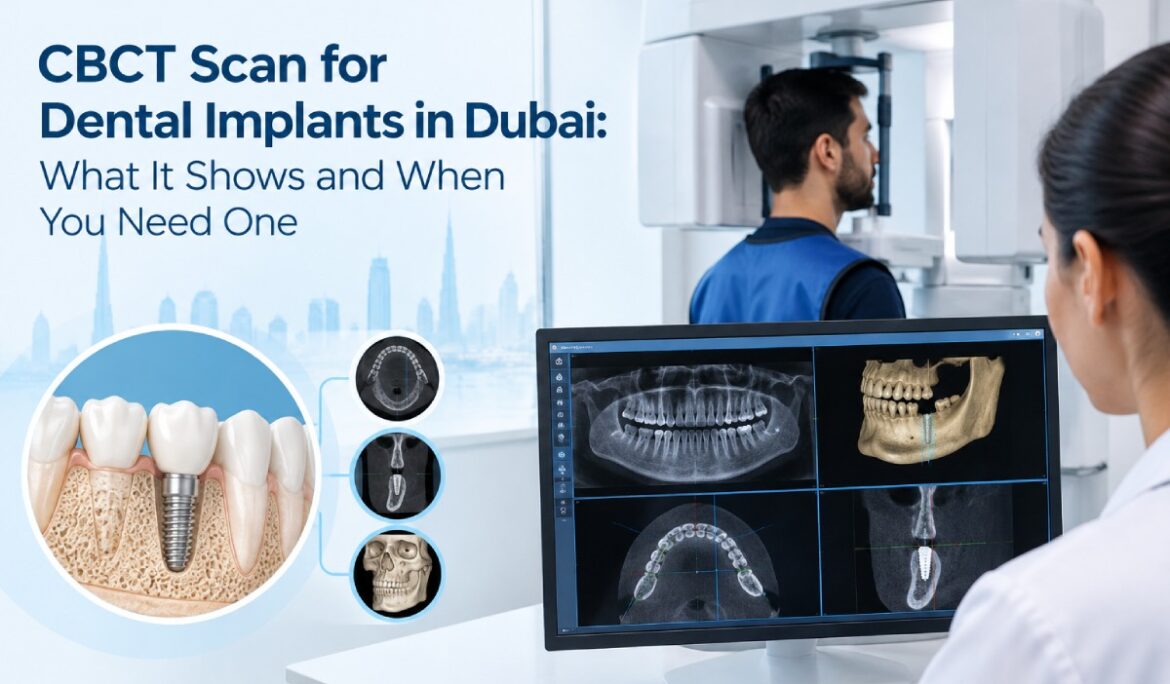
A CBCT scan is a 3D dental X-ray that gives detailed views of the teeth, the jawbone, and important structures such as the lower jaw nerve canal and the maxillary sinuses. For dental implants, it lets the dentist measure the bone’s height and width, find structures the implant must avoid, and plan the implant’s position before surgery. A standard 2D X-ray can’t do this reliably.
Not every implant patient needs one. Whether a CBCT scan for dental implants in Dubai is recommended depends on the implant site, the anatomy, and how complex the treatment is. Every CBCT scan for dental implants in Dubai is prescribed only when the additional 3D information can improve diagnosis and treatment planning. The dentist should be able to explain why it’s needed in your case.
Quick Answer
A dental CBCT scan shows bone height, width, and shape, the position of the lower jaw nerve, the floor of the maxillary sinus, the roots of neighbouring teeth, and any infection or bone defects. It’s used in implant planning when three-dimensional information is needed, especially near the nerve or sinus, where bone may be limited, or for immediate or guided implant placement.
The radiation dose is higher than a standard dental X-ray but usually lower than a conventional medical CT. The scan should be used only when it adds information that affects the plan. For many patients considering implants, a dental CBCT scan Dubai clinic can provide the detailed images needed before surgery.
A CBCT scan for dental implants in Dubai is particularly valuable when important anatomical structures need to be assessed accurately. For many patients considering implants, a dental CBCT scan Dubai clinic can provide the detailed images needed before surgery. A CBCT scan for dental implants in Dubai is particularly valuable when important anatomical structures need to be assessed accurately.
What Is a Dental CBCT Scan?
CBCT stands for cone beam computed tomography. The scanner rotates once around your head while you sit or stand still. It captures a cone-shaped X-ray beam and turns it into a 3D model that the dentist can slice and view from any angle. The area scanned is called the field of view. A small field of view covers one or two teeth. A larger one covers a whole jaw or both jaws. Dentists aim to scan only the area they need.
What Does a CBCT Scan Show?
| What the scan shows | Why it matters for an implant |
| Bone height | Whether an implant of suitable length fits without reaching the nerve or sinus |
| Bone width and shape | Whether the ridge is wide enough, or whether bone grafting is needed |
| Lower jaw nerve (mandibular canal) | Implants in the lower back teeth have to keep a safe distance from it |
| Maxillary sinus | Upper back implants may need a sinus lift if bone below the sinus is thin |
| Neighbouring roots | The implant has to sit between them without contact |
| Infection, cysts or defects | These may need treatment before implant placement |
| Extraction socket and facial bone | Helps decide whether an implant can go in immediately after extraction |
| Bone quality (approximate) | Indicates bone density, although CBCT grey values aren’t a precise density measurement |
For implant planning, the main advantage of CBCT is that it shows the three-dimensional relationship between the proposed implant site and the important structures around it.
CBCT vs Panoramic X-ray for Implants
In a CBCT vs panoramic X-ray for implants comparison, a panoramic X-ray, often called an OPG (orthopantomogram), gives a 2D overview of both jaws. It’s useful for screening, but it has limits for implant planning.
| Feature | Panoramic X-ray (OPG) | CBCT scan |
| Dimensions | 2D | 3D |
| Bone width | Can’t be assessed reliably in three dimensions | Measured directly |
| Measurement accuracy | Magnification and distortion vary across the image | Measurements can be made in any plane |
| Nerve and sinus position | Approximate | Located in three dimensions |
| Radiation dose | Lower | Higher, depending on field of view |
| Typical role | First overview and screening | Detailed planning when 3D information is needed |
In practice, CBCT and OPG often work together. The OPG gives the overview, and the CBCT answers the specific questions a 2D image can’t.
Do You Always Need a CBCT Scan for Dental Implants?
No. A CBCT scan for dental implants isn’t automatically required for every dental implant patient. The decision depends on the implant site, the available bone, the nearby anatomical structures, and how complex the planned treatment is. If a 2D X-ray and clinical examination give enough information, additional 3D imaging may not be necessary.
So is a CBCT scan for dental implants in Dubai necessary? It is when three-dimensional information would change or confirm the treatment plan. Radiology guidance recommends that CBCT is clinically justified in each case and that the smallest appropriate field of view is used.
When Might You Need a CBCT Before an Implant?
| Situation | Is 3D imaging often useful? | Why |
| Simple single-tooth implant with clearly adequate bone | Sometimes | 2D imaging may give enough information in selected cases |
| Lower molar or premolar implant | Often | Helps assess the mandibular nerve |
| Upper molar implant | Often | Helps assess sinus anatomy and available bone |
| Thin or narrow ridge | Often | Helps evaluate three-dimensional bone volume |
| Bone graft or sinus lift planned | Often | Helps assess the defect and plan augmentation |
| Immediate implant after extraction | Often | Helps assess the socket and surrounding bone |
| Multiple or full-arch implants | Often | Allows three-dimensional planning across the arch |
| Guided implant surgery | Usually | The surgical guide is designed from the 3D data |
| Problem with an existing implant | Often | Helps assess bone around the implant and nearby structures |
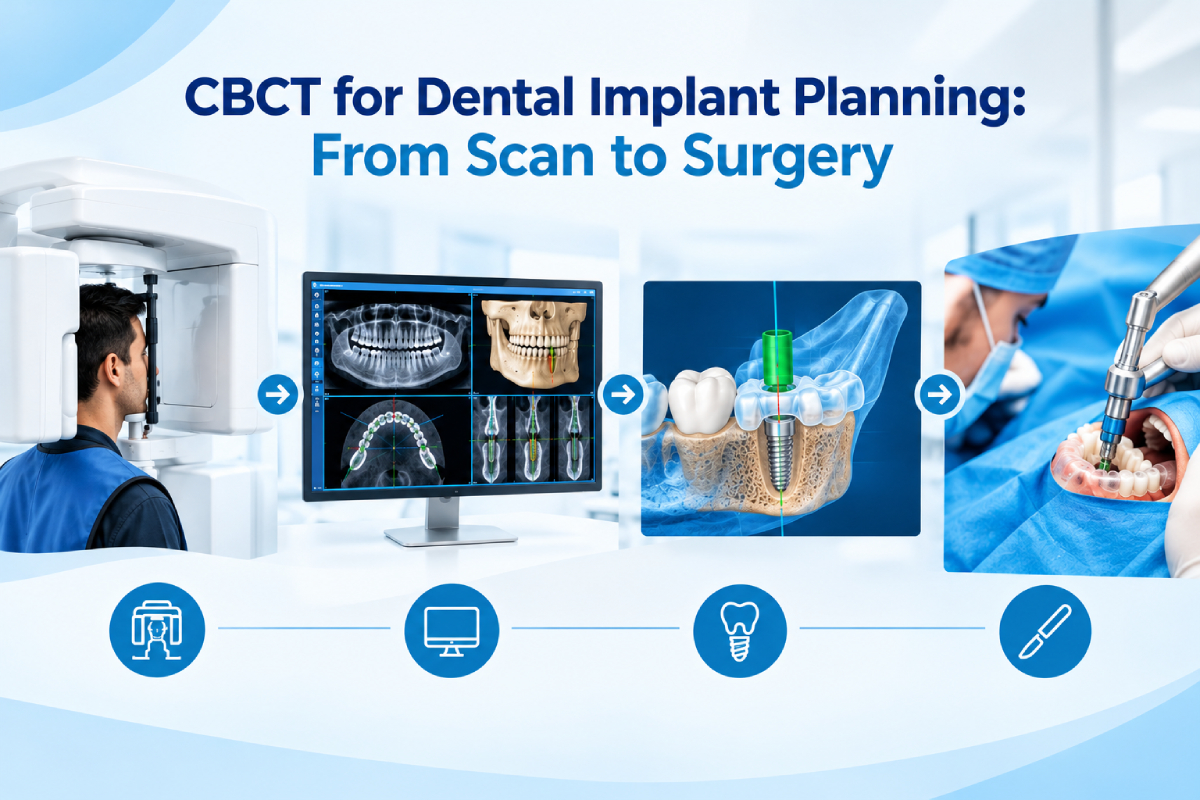
CBCT for Dental Implant Planning: From Scan to Surgery
CBCT for dental implant planning usually follows these steps for accurate dental implant planning Dubai clinics perform:
- Clinical examination: gums, bite, the gap, and neighbouring teeth are checked.
- CBCT scan: of the planned area only, where it’s needed.
- Digital planning: the scan is combined with a digital impression of the teeth, and the implant is positioned virtually as part of CBCT for dental implant planning. The final position is planned around the available bone and also around the position and shape of the final crown.
- Treatment decision: straightforward placement, bone grafting first, a sinus lift, immediate placement, or a staged approach.
- Surgical guide (if used): a printed guide transfers the digital plan to surgery.
- Follow-up imaging: a 2D X-ray is usually enough. Another CBCT is taken only if there’s a specific reason.
The scan doesn’t decide the treatment on its own. It gives the clinician the information to explain your options clearly, including when same-day implant treatment is or isn’t appropriate.
How long does a dental CBCT scan take?
The scan itself is usually completed in less than a minute. Positioning and preparation make the overall appointment longer.
Is a CBCT Scan Safe?
CBCT is generally considered safe when it’s clinically justified and performed with appropriate exposure settings, but it does involve ionising radiation. The dose depends on the machine, the exposure settings, and the field of view. It’s generally higher than a single dental X-ray and usually lower than a conventional medical CT scan of the same area.
Scanning only the smallest area needed keeps exposure down. If you’re pregnant or may be pregnant, tell your dentist before any X-ray or CBCT examination. The clinician can consider whether the imaging is necessary and how to minimise exposure. Metal crowns, fillings, or existing implants can create streaks (artefacts) on the image, and the clinician will take these into account when reading the scan.
How Much Does a CBCT Scan Cost in Dubai?
CBCT scan price in Dubai varies with the area being scanned, the field of view, the imaging requirements, and whether a radiology report or digital implant planning is included when a dental CBCT scan Dubai clinic provides.
Before comparing CBCT scan price in Dubai between clinics, check whether the quoted fee includes the scan, the interpretation or report, the digital files, and any implant planning. A lower headline price may not be for the same service.
What to ask when comparing CBCT prices:
- Is this a small, single-site scan or a full-jaw scan?
- Is a radiologist’s report included?
- Are the DICOM files (the digital scan data) included?
- Is digital implant planning included?
- Is the scan done at the clinic or at an external imaging centre?
- Is it included in the implant consultation fee?
For how imaging fits into the overall treatment budget, see our dental implant cost page.
Implant Imaging Decision Pathway
- A missing or failing tooth. Clinical examination follows.
- Is the site simple, with clearly adequate bone and no nearby nerve or sinus concerns?
• Yes:2D imaging may be enough. The clinician decides.
• No, or uncertain: CBCT scan for dental implants in Dubai of the planned area. - What does the scan show?
• Adequate bone: plan the implant position, with a guide if appropriate.
• Limited bone: bone grafting or a sinus lift, then implant.
• Infection or a lesion: treat first, then re-plan. - Surgery, then healing, then the final restoration.
Examples of How CBCT Changes the Plan
These are illustrations, not case reports.
- A lower first molar missing for several years: the bone may have narrowed, making a CBCT scan for dental implants useful for accurate assessment. CBCT shows the ridge width and the distance to the nerve, which decides the implant size or whether a graft is needed.
- An upper molar next to the sinus: CBCT measures the bone height below the sinus floor, showing whether a standard implant fits or a sinus lift is needed first.
- A front tooth to be extracted and replaced the same day: CBCT shows the thickness of the thin facial bone, which influences whether immediate placement is suitable.
- A full-arch plan: CBCT maps bone across the whole jaw, so implant positions can be distributed safely.
Dental Implant Planning in Dubai: CBCT at Bay Avenue
At Bay Avenue Dental Centre in Business Bay, dental CBCT scan Dubai imaging may be used as part of dental implant planning Dubai when three-dimensional information is needed. The scan is reviewed alongside the clinical examination to assess bone availability, anatomical structures, and the proposed implant position. Dr. Alok Mehta, Specialist Periodontist & Implantologist, uses this assessment to decide whether an implant can be placed directly, needs bone grafting or a sinus lift first, or should be staged.
Bay Avenue Dental Centre is at The Regal Tower, Office 1701, Business Bay, Dubai.
Dental CBCT Scan: Dubai Patients’ Common Questions
What does a CBCT scan show for dental implants?
It shows bone height, width, and shape, the lower jaw nerve, the sinus, neighbouring roots, and any infection or defects. This is the information needed to position an implant safely.
Do I always need a CBCT scan for dental implants in Dubai before an implant?
No. CBCT is generally used when three-dimensional information is needed to assess the implant site or nearby anatomy, and when that information would affect treatment planning.
Does a CBCT scan hurt?
No. A CBCT scan is non-invasive and involves no injections and no contact with the teeth. You simply stay still while the scanner captures the images.
Do I need to prepare for a dental CBCT scan?
Usually very little preparation is needed. You may be asked to remove metal objects such as jewellery, glasses, or removable dental appliances that could interfere with the images. Follow the specific instructions from your dentist or imaging centre.
Is a CBCT scan better than an OPG?
They do different jobs. An OPG gives a 2D overview at a lower dose, and CBCT gives 3D detail when it’s needed. They’re often used together.
Can a CBCT scan show whether I need a bone graft?
Yes. It measures the available bone, which helps decide whether grafting or a sinus lift is needed before the implant.
Can I use a CBCT scan taken at another clinic?
Often, yes, if it’s recent, covers the right area, and is of suitable quality. Bring the digital DICOM files, not just printed images.
Not sure whether you need a CBCT scan before an implant? An implant consultation can decide whether 3D imaging is needed for your case and what it would show before any treatment is recommended.
Book a dental implant consultation at Bay Avenue Dental Centre, Business Bay · +971 55 146 5512 · +971 4 277 0247 · info@bayavenuedc.com