Periodontal Flap Surgery in Dubai: When Deep Cleaning Isn’t Enough
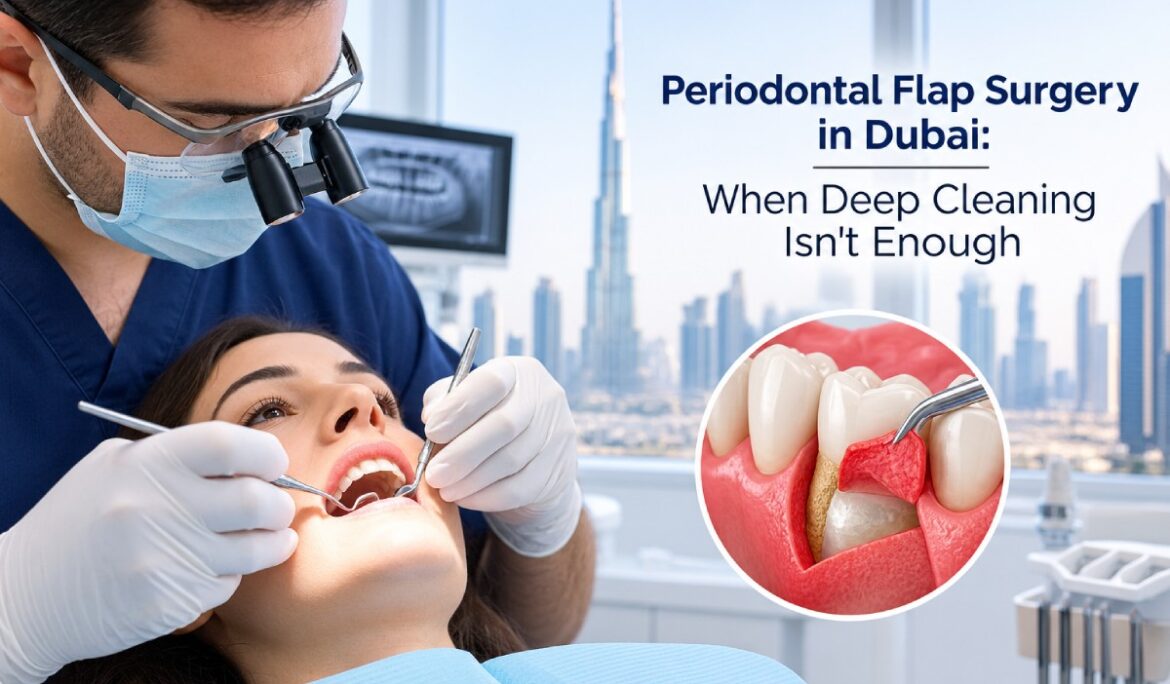
Periodontal flap surgery is a gum procedure that gently lifts the gum away from the teeth so the periodontist can clean deep root surfaces and bone defects that can’t be reached from above the gum. It can form part of advanced gum disease treatment Dubai when deep gum pockets remain after a thorough course of deep cleaning.
The main aims of flap surgery for gum disease are to control the infection, reduce pocket depth, and protect the bone that holds the teeth. Most people with gum disease never need surgery. Periodontal flap surgery in Dubai, as elsewhere, is a later step in treatment, considered only after non-surgical care has been completed and reassessed.
Quick Answer
When is periodontal flap surgery needed? It is generally considered when clinically significant periodontal pockets remain after appropriate non-surgical treatment and reassessment. Pocket depth is important, but the decision also depends on bleeding, bone defects, anatomy, plaque control, and the long-term outlook for the affected teeth.
In periodontal flap surgery in Dubai, the gum is lifted under local anaesthetic, the roots and bone defects are cleaned, and the gum is repositioned and stitched. It usually heals over one to two weeks. In suitable defects, bone-regenerating materials can be placed at the same time. The procedure doesn’t cure gum disease on its own; regular maintenance afterwards is essential.
What Is Periodontal Flap Surgery?
Gum flap surgery in Dubai is another term patients may use for periodontal flap surgery. Both describe the same procedure and are commonly discussed when considering periodontal flap surgery in Dubai. In advanced gum disease, the gum detaches from the tooth and forms a pocket.
Bacteria and hardened deposits (calculus) collect deep in that pocket, often around root grooves, between roots, or in bone craters. Instruments used from above the gumline can’t always reach these areas. During surgery, a periodontist in Dubai makes small incisions and folds back a section of gum like a flap. This gives a direct view of the roots and bone.
There are three main types:
- Access flap (open flap debridement): the main aim is thorough cleaning under direct vision.
- Pocket reduction (resective) surgery: the bone and gum are reshaped so that shallower pockets remain, which are easier to keep clean.
- Regenerative surgery: in suitable bone defects, materials such as bone grafts, membranes, or biologic agents are used to help rebuild lost support.
When Is Periodontal Flap Surgery Needed?
Understanding when periodontal flap surgery is needed starts with assessing whether significant pockets remain after non-surgical treatment has been completed and reassessed.
European periodontal guidelines describe treatment in steps:
- Step 1: oral hygiene instruction, plaque control, and managing risk factors such as smoking and diabetes.
- Step 2: deep cleaning below the gumline (subgingival instrumentation).
- Reassessment: after healing, the pockets are measured again.
- Step 3: residual pockets are treated. Some are cleaned again; others may need flap surgery for gum disease.
- Step 4: supportive periodontal care for life.
Residual deep pockets, particularly those of around 6 mm or more, may make periodontal flap surgery in Dubai appropriate when they remain after appropriate non-surgical treatment and reassessment. Pocket depth is only one factor. Bleeding, anatomy, bone defects, furcation involvement, plaque control, and the overall periodontal prognosis also influence the decision.
In simple terms: if deep cleaning reduces the pockets and inflammation, surgery may not be necessary. If significant pockets remain after healing and reassessment, your periodontist may recommend further treatment, which can include flap surgery or regenerative procedures depending on the defect. Steps 1 and 2 are covered in more detail on our gum disease treatment page.
Can Periodontal Flap Surgery Be Avoided?
Often, yes. Gum flap surgery in Dubai isn’t usually the first treatment for gum disease. Professional subgingival cleaning, better plaque control, managing risk factors, and periodontal maintenance can control many cases without surgery.
Understanding when periodontal flap surgery needed is important because surgery becomes relevant when clinically significant pockets or defects remain after appropriate non-surgical treatment and reassessment. How well you clean at home between visits has a real effect on whether surgery is needed.
Deep Cleaning vs Flap Surgery
Deep cleaning vs flap surgery is best understood as a staged approach: deep cleaning comes first, while flap surgery treats what deep cleaning couldn’t resolve. They’re stages of the same treatment, not rival options.
| Feature | Deep cleaning (scaling and root debridement) | Periodontal flap surgery |
| When used | First-line treatment for periodontitis | Significant pockets remaining after deep cleaning |
| Access | Instruments work below the gum without opening it | Gum is lifted to expose roots and bone |
| Reach | Can treat periodontal pockets without surgically opening the gum; effectiveness depends on pocket depth and anatomy | Deep pockets, root grooves, furcations and bone defects under direct vision |
| Anaesthesia | Local anaesthetic as needed | Local anaesthetic |
| Stitches | No | Yes |
| Bone reshaping or regeneration | Not possible | Possible where indicated |
| Recovery | Usually minimal | Tenderness for a few days; stitches removed after 1–2 weeks |
Gum flap surgery in Dubai and deep cleaning differ mainly in how the affected areas are accessed. In deep cleaning vs flap surgery, the key difference is access: when a pocket is deep or has an irregular bone defect, direct vision can allow more thorough cleaning.
When Might Flap Surgery Be Recommended?
| Situation after deep cleaning | Is surgery often considered? | Why |
| Pockets now shallow and not bleeding | No | Maintenance is usually enough |
| Moderate pockets that still bleed | Sometimes | Repeating deep cleaning is often tried first |
| Residual pockets of around 6 mm or more | Often considered | Surgical access may be needed; depth is one factor among several |
| Vertical (intrabony) bone defect | Often | Regenerative surgery may be possible |
| Bone loss between the roots of a molar (furcation) | Often | These areas are difficult to clean non-surgically |
| Poor plaque control or heavy smoking | Delay is often advised | Results are better once risk factors are controlled |
This table is a guide only. A periodontist in Dubai decides based on the measurements, X-rays, and your overall health.
What Happens During Gum Flap Surgery?
- Planning with a periodontist in Dubai: periodontal charting, X-rays, and a review of your medical history. A 3D scan is occasionally used for complex bone defects.
- Local anaesthetic: the area is numbed.
- Flap and cleaning: the gum is lifted, and deposits and inflamed tissue are removed from the roots and bone. Flap surgery for gum disease aims to reach areas that can’t be adequately cleaned without surgery and to treat the defect according to its shape.
- Reshaping or regeneration: the bone is contoured, or regenerative materials are placed where suitable.
- Closure: the gum is repositioned and stitched. A protective dressing may be placed.
Each area of periodontal flap surgery in Dubai commonly takes one to two hours, depending on how many teeth are involved.
How many visits are needed for periodontal flap surgery?
There’s no fixed number. It depends on how many areas need surgery, how severe the disease is, the treatment plan, and whether regenerative procedures are included. Areas are often treated at separate appointments, with follow-up visits for stitch removal and healing checks. Your periodontist will outline a schedule after the assessment.
Recovery After Periodontal Flap Surgery
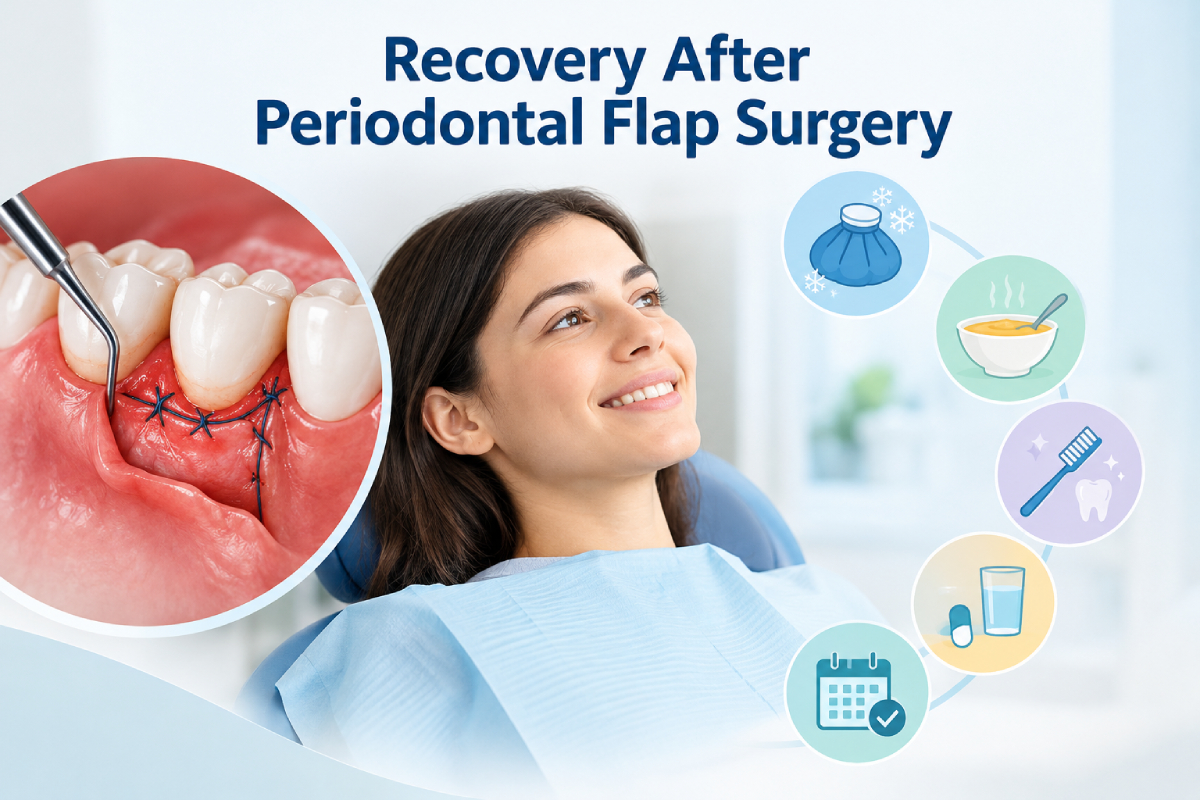
- The first few days: tenderness and some swelling are common and are usually managed with the pain relief the dentist recommends.
- Diet: soft, cool foods for several days. Avoid chewing directly on the treated area.
- Cleaning: an antibacterial mouthrinse may be prescribed. Brush the rest of the mouth normally and follow the instructions for the treated area.
- Stitches: usually removed or checked after one to two weeks.
- Smoking: avoiding it improves healing.
After gum flap surgery in Dubai, the gum may feel better before the tissues underneath have fully matured, so follow-up and maintenance still matter after the initial discomfort settles.
Possible changes after surgery: as the gums heal and pockets shrink, the gumline may sit slightly lower. Some people notice more visible roots, sensitivity to cold, or small spaces between teeth. These are known effects of reducing pockets and can often be managed; your periodontist should discuss them before treatment.
What Happens If Deep Gum Pockets Are Left Untreated?
Deep pockets are hard to keep clean, so bacteria can continue to build up in them.
Over time, this can lead to:
- ongoing inflammation and bleeding;
- further loss of the gum attachment and supporting bone;
- teeth becoming mobile or drifting;
- disease that is harder to control;
- more complex treatment planning later, sometimes including decisions about keeping or replacing teeth.
This doesn’t happen at the same speed for everyone. Regular measurements show whether the pockets are stable or getting worse, and that helps you and your periodontist decide when to act.
Is Flap Surgery Right for Everyone?
No.
As part of advanced gum disease treatment Dubai, surgery may be postponed or reconsidered when:
- deep cleaning and home care haven’t yet been completed or reassessed;
- plaque control isn’t yet good enough to protect the result;
- diabetes or another medical condition isn’t well controlled;
- the tooth’s long-term outlook is too poor to justify surgery, where extraction and replacement may be discussed instead.
What Determines Periodontal Flap Surgery Cost in Dubai?
Periodontal flap surgery cost in Dubai varies because treatment may involve one tooth, one quadrant, several areas, or regenerative procedures. Quotes can also differ depending on whether periodontal charting, X-rays, grafting materials, membranes, follow-up visits, and maintenance are included.
The main factors are:
- Extent: the number of teeth or areas treated can affect periodontal flap surgery cost in Dubai.
- Type of surgery: an access flap, resective surgery, or regenerative surgery.
- Materials: regenerative products add to the cost.
- Assessment and imaging: charting and X-rays, plus 3D imaging in complex cases.
- Aftercare: post-operative reviews and the supportive maintenance programme.
What to ask when comparing quotes:
- How many areas and teeth does the quote cover?
- Is it an access flap, resective, or regenerative procedure?
- Are graft materials or membranes included?
- Are follow-up visits and stitch removal included?
- What maintenance will be needed afterwards, and how often?
Who Performs Flap Surgery? Choosing a Periodontist in Dubai
A periodontist is a dental specialist trained to diagnose and treat diseases affecting the gums and the bone that supports the teeth. Periodontal surgery is usually carried out by a periodontist. When choosing a periodontist in Dubai,
ask about:
- how they measure and track your pockets over time;
- why surgery is recommended over repeating deep cleaning;
- whether regenerative options suit your bone defects;
- what results and side effects to expect in your case;
- the maintenance plan after surgery.
Flap Surgery in Business Bay: Care at Bay Avenue Dental Centre
At Bay Avenue Dental Centre, gum treatment follows a staged approach: non-surgical care first, then reassessment, and surgery only where significant pockets remain. Dr. Alok Mehta, Specialist Periodontist & Implantologist, provides non-surgical and surgical periodontal treatment, including regenerative procedures where they’re suitable. Where active infection or an abscess needs attention first, see our gum infection treatment page.
Bay Avenue Dental Centre is at The Regal Tower, Office 1701, Business Bay, Dubai.
Advanced Gum Disease Treatment Dubai: Common Questions
Is periodontal flap surgery painful?
The area is numbed during the procedure. Tenderness and swelling afterwards are common for a few days and are usually managed with the pain relief your dentist recommends.
How long does recovery take?
Most people return to normal routines within a few days. Stitches are usually removed after one to two weeks, and the tissues continue to mature over the following weeks.
Is periodontal flap surgery the same as periodontal surgery?
Periodontal surgery is a broader term covering several procedures that treat problems with the gums and supporting bone. Flap surgery is one type of periodontal surgery; it gives access to the roots and supporting tissues beneath the gum.
Does dental insurance cover periodontal flap surgery in Dubai?
Coverage depends on the policy, the diagnosis, and the insurer. Some plans cover medically indicated periodontal treatment partly or fully, while others exclude specific procedures or have annual limits. Confirm your benefits with your insurer before treatment.
Will my gums look different after flap surgery?
The gumline may sit slightly lower as the pockets shrink, and some roots may become more visible. Your periodontist should explain this before treatment.
Can lost bone be rebuilt during flap surgery?
In some defects, yes. Regenerative materials may be used where the bone shape is suitable. Not every defect can be regenerated.
Does periodontal flap surgery in Dubai cure gum disease?
No. It treats the remaining pockets, but periodontitis needs lifelong maintenance and good daily cleaning to stay stable.
Is flap surgery the same as a gum graft?
No. Flap surgery for gum disease treats deep pockets and bone defects. Gum grafting treats recession by covering exposed roots.
Still have deep pockets after a deep clean? A periodontist in Dubai can perform a periodontal reassessment to measure your pockets, review your X-rays, and explain whether further non-surgical care or flap surgery is appropriate.
Book a gum assessment at Bay Avenue Dental Centre, Business Bay · +971 55 146 5512 · +971 4 277 0247 · info@bayavenuedc.com