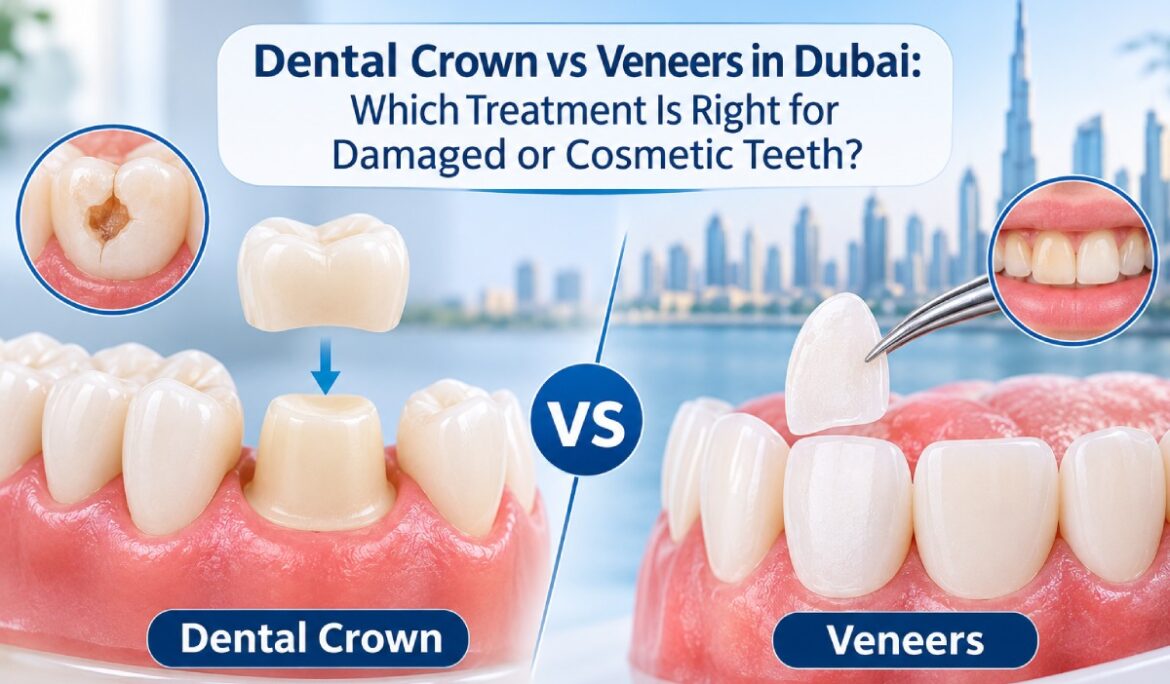
Dental Crown vs Veneers in Dubai: Which Treatment Is Right for Damaged or Cosmetic Teeth?
Introduction: Dental Crown or Veneer – Which One Is Right for Your Tooth?
If you have chipped, discoloured, cracked, worn, misshapen or damaged teeth, you may have already come across two popular treatment options: dental crowns and veneers. At first glance, they can appear similar because both can improve the appearance of a tooth. However, dental crowns vs veneers involves two treatments designed for very different clinical situations.
A veneer is primarily a cosmetic restoration that covers the visible front surface of a tooth. A dental crown surrounds the tooth and is generally used when the tooth needs greater structural protection or restoration. This distinction is particularly important when searching for dental crowns Dubai or veneers Dubai, because choosing a treatment based only on appearance or price can overlook the condition of the underlying tooth.
For example:
- A healthy front tooth with severe staining may be considered for veneers.
- A tooth with a large filling and weakened structure may need a crown.
- A small chip may need only bonding.
- Crooked teeth may be better treated with orthodontics.
- A missing tooth cannot be restored with a veneer or conventional crown and may require an implant-supported restoration.
Therefore, the right question is not: “Are veneers better than crowns?” The better question is: “What does my tooth actually need – cosmetic enhancement, structural protection, alignment, or replacement?”
That is why choosing the right cosmetic dental treatment Dubai should begin with a professional assessment. A cosmetic dentist Dubai or restorative dentist should evaluate the condition of the tooth before recommending veneers, crowns or another option.
Dental Crowns vs Veneers: The Fundamental Difference
The simplest way to understand dental crowns vs veneers is to look at how much of the tooth each restoration covers.
Veneers
A veneer is a thin, custom-made covering bonded primarily to the front surface of the tooth.
Veneers are commonly considered for aesthetic concerns such as:
- discoloration
- minor chips
- small gaps
- irregular tooth shape
- certain cosmetic size discrepancies
- selected mild appearance concerns
The American Dental Association explains that veneers cover the front surface rather than the entire tooth.
Dental Crowns
A crown is a tooth-shaped restoration that fits over the remaining tooth structure.
Crowns are generally used when a tooth needs:
- structural reinforcement
- protection after significant damage
- restoration after extensive decay
- restoration following root canal treatment
- replacement of a large or failing restoration
- protection from further fracture
Cleveland Clinic describes crowns as restorations used to restore decayed, broken, weak or worn teeth and notes that they can also cover root-canal-treated teeth and dental implants.
The key distinction
Veneer = primarily front-surface cosmetic coverage
Crown = substantially greater coverage for restoration and protection
This is why a crown is not simply a “thicker veneer.”
Understanding dental crowns vs veneers is essential before choosing a restoration, because the two treatments differ in coverage, preparation, purpose, and the amount of structural protection they provide. They serve different purposes.
Veneers vs Crowns: Cosmetic Treatment or Restorative Treatment?
Another useful way to compare veneers vs crowns is to understand the primary objective.
Veneers Are Usually Cosmetic
Veneers are generally chosen when the underlying tooth is reasonably healthy but its appearance is not ideal.
For example, a patient may have:
- healthy but heavily stained teeth
- minor chips
- uneven tooth shapes
- small spaces
- worn-looking front teeth
- teeth that appear too short or narrow
A veneer can change the visible colour, shape and proportions of the tooth without covering the entire tooth. However, veneers are not intended to substitute for treatment of active decay or significant structural damage. The American Dental Association recommends addressing problems such as decay or gum disease before veneer treatment.
Crowns Are Usually Restorative
Crowns are commonly selected when preserving and protecting the remaining tooth structure is the priority.
For example:
- Large filling → weakened tooth → crown
- Deep decay → root canal → crown
- Major fracture → insufficient remaining structure → crown
The crown surrounds the tooth and provides a protective restoration.
Cleveland Clinic notes that crowns can strengthen weak teeth, protect cracked teeth and restore worn or broken teeth.
Why this distinction matters
If a dentist recommends a crown for a structurally weak tooth, choosing a veneer simply because it is more conservative cosmetically may not provide the protection the tooth needs.
Conversely, putting a crown on an otherwise healthy tooth purely to change its appearance may involve more tooth preparation than a veneer-based cosmetic approach. The condition of the natural tooth should come before the cosmetic preference.
Dental Crown vs Veneer: Which Covers More of the Tooth?
Coverage is one of the clearest differences when comparing dental crowns vs veneers.
Veneer Coverage
A veneer primarily covers the visible front surface of the tooth and may extend around selected edges depending on the design. Its purpose is to change the appearance of the visible tooth structure.
Crown Coverage
A crown covers the tooth more extensively, surrounding the remaining clinical tooth structure. This provides a greater degree of protection when the tooth has lost substantial structure.
Think of it this way:
- Veneer: A carefully designed facade attached to the front of the tooth.
- Crown: A protective restoration that surrounds the remaining tooth.
The ADA defines a crown as an artificial replacement that restores missing tooth structure by surrounding the remaining coronal tooth structure. When comparing dental crowns vs veneers, coverage is one of the most important clinical differences.
Tooth Preparation: Veneers vs Crowns
Patients often ask: “How much of my natural tooth needs to be removed?” There is no single number that applies to every patient or every restoration.
The amount of tooth preparation depends on factors such as:
- material selected
- existing tooth position
- tooth colour
- desired final shape
- restoration thickness
- bite
- existing damage
- laboratory requirements
- dentist’s treatment plan
Generally, veneers require less tooth reduction than conventional crowns because they cover less of the tooth. The American Dental Association notes that porcelain veneers involve removing a small amount of enamel from the front and sides of the tooth before bonding.
Crowns require more extensive preparation because sufficient space must be created for the crown to fit over the tooth while maintaining appropriate shape and function.
Why preparation matters
The objective is not simply: “Remove as little tooth as possible.” It is: “Remove only what is necessary to create a healthy, functional and predictable restoration.”
Too little preparation can create problems with restoration thickness, contours or bite. Too much unnecessary removal sacrifices healthy tooth structure. A good cosmetic or restorative dentist should explain the planned preparation before treatment begins.
Are Veneers More Conservative Than Crowns?
In many cases, yes – but “more conservative” does not mean “better for every tooth.” A veneer may preserve more natural tooth structure because it covers only part of the tooth.
This can make it attractive for patients whose teeth are:
- structurally healthy
- relatively intact
- primarily affected by cosmetic concerns
However, veneers are not completely non-invasive. Porcelain veneers typically require some enamel removal, and the treatment is generally considered irreversible.
The ADA specifically notes that veneer treatment is not reversible because enamel is removed during placement. Crowns involve more extensive preparation because they need to fit over the tooth.
Therefore:
- If the tooth is healthy but cosmetically imperfect: A veneer may be considered.
- If the tooth is structurally compromised: A crown may provide the protection required.
The goal should be appropriate preservation of healthy tooth structure, not simply choosing the restoration that requires the least preparation.
Dental Crowns vs Veneers for Front Teeth
This is one of the most searched practical questions: Should I get a crown or veneer for my front tooth? When considering a crown or veneer for front teeth, the answer depends on why the front tooth needs treatment.
Veneer May Be Considered When:
- the tooth is structurally healthy
- the main concern is appearance
- there is significant discoloration
- the tooth has a minor chip
- the shape is cosmetically undesirable
- there is a small gap
- the patient wants a smile makeover
Veneers are commonly used for front teeth because they can modify colour, shape and proportions while preserving more of the tooth than a full crown in appropriate cases.
Crown May Be Considered When:
- the tooth is substantially weakened
- there is extensive decay
- a large filling has compromised the tooth
- the tooth has a significant fracture
- the tooth has undergone root canal treatment and needs appropriate restoration
- insufficient natural tooth remains for a more conservative restoration
- Crowns are specifically used to restore and protect damaged or weakened teeth.
Example
Imagine two patients with discoloured front teeth.
Patient A:
The teeth are healthy but have severe intrinsic discoloration that has not responded adequately to whitening. A veneer may be considered.
Patient B:
The tooth is discoloured because it has undergone root canal treatment and has significant structural loss. A crown may be more appropriate.
The visible problem is similar- discolouration- but the underlying clinical situation is completely different. Treatment should be based on the condition of the tooth, not simply the visible symptom.
When Are Dental Veneers in Dubai Usually Considered?
Patients searching for veneers Dubai often want to correct multiple cosmetic concerns at once.
Common situations include:
Discoloured Teeth
Veneers may be considered when discoloration is persistent and does not respond adequately to whitening. Cleveland Clinic notes that porcelain veneers may be an option for widespread discoloration that does not improve with whitening.
Minor Chips
Veneers can camouflage selected chips or changes in the shape of the tooth. However, a very small chip may be better managed with bonding.
Uneven Tooth Shape
A veneer can modify the visible contour of a tooth.
Small Gaps
Veneers may sometimes close or visually mask small spaces between teeth.
Mild Shape Irregularities
Teeth that appear too short, narrow or disproportionate can sometimes be improved through carefully planned veneers.
Smile Makeover
Several cosmetic issues may be addressed together through a planned smile makeover.
But this does not mean every patient needs veneers. For patients considering veneers Dubai, the final decision should follow a detailed examination rather than simply the number of teeth visible when smiling.
When Are Dental Crowns in Dubai Usually Considered?
Patients searching for dental crowns Dubai may be dealing with a tooth that has lost substantial structure.
Common situations include:
Large Cavities
If decay has removed too much tooth structure for a conventional filling to provide adequate restoration, a crown may be considered.
Large Existing Fillings
A tooth with a large filling may have reduced remaining structure and require additional protection. The ADA notes that crowns can help strengthen teeth with large fillings when insufficient tooth structure remains to support the filling.
Cracked or Broken Teeth
A crown can protect and restore an appropriately treatable damaged tooth.
Root Canal-Treated Teeth
Some root-canal-treated teeth require a crown or another appropriate definitive restoration depending on the remaining tooth structure and clinical circumstances.
Severe Wear
Significantly worn teeth may require restorative treatment to rebuild form and function.
Implant Restoration
A crown can also be attached to a dental implant to replace the visible portion of a missing tooth.
A crown is often selected because the tooth needs protection and structural restoration, not simply because the patient wants a different appearance.
Porcelain Veneers vs Porcelain Crowns
The word porcelain can make the two treatments sound more similar than they actually are. Patients considering porcelain crowns Dubai should understand that porcelain or ceramic crowns are designed to provide greater tooth coverage. Both veneers and crowns can be made using tooth-coloured ceramic materials, but their design and purpose remain different.
Porcelain Veneers
A porcelain veneer is a thin custom-made shell designed primarily for the visible tooth surface. For patients considering porcelain veneers Dubai, this option can be particularly relevant when the teeth are suitable for cosmetic treatment.
It is particularly useful for carefully selected cosmetic cases.
Potential advantages include:
- natural-looking appearance
- colour customization
- control over tooth shape
- high aesthetic potential
- conservative coverage compared with a full crown
The ADA describes porcelain veneers as strong, long-lasting and natural-looking, while also noting that they are more expensive than composite veneers and are not reversible.
Porcelain or Ceramic Crowns
A ceramic crown can provide both aesthetic and structural restoration. For patients researching porcelain crowns Dubai, it is important to understand that ceramic crowns are designed according to the clinical and functional requirements of the tooth.
Modern ceramic systems can provide highly aesthetic results while also being designed for functional demands. The ADA notes that ceramic materials are increasingly used for tooth-coloured restorations and that different ceramic classes are intended for different clinical applications and strength requirements. This means “porcelain crown” is not one single material with identical properties in every situation.
Your dentist may recommend a particular ceramic based on:
- tooth position
- bite forces
- amount of remaining tooth structure
- aesthetic requirements
- restoration design
- functional demands
Material selection should follow the clinical indication rather than the other way around.
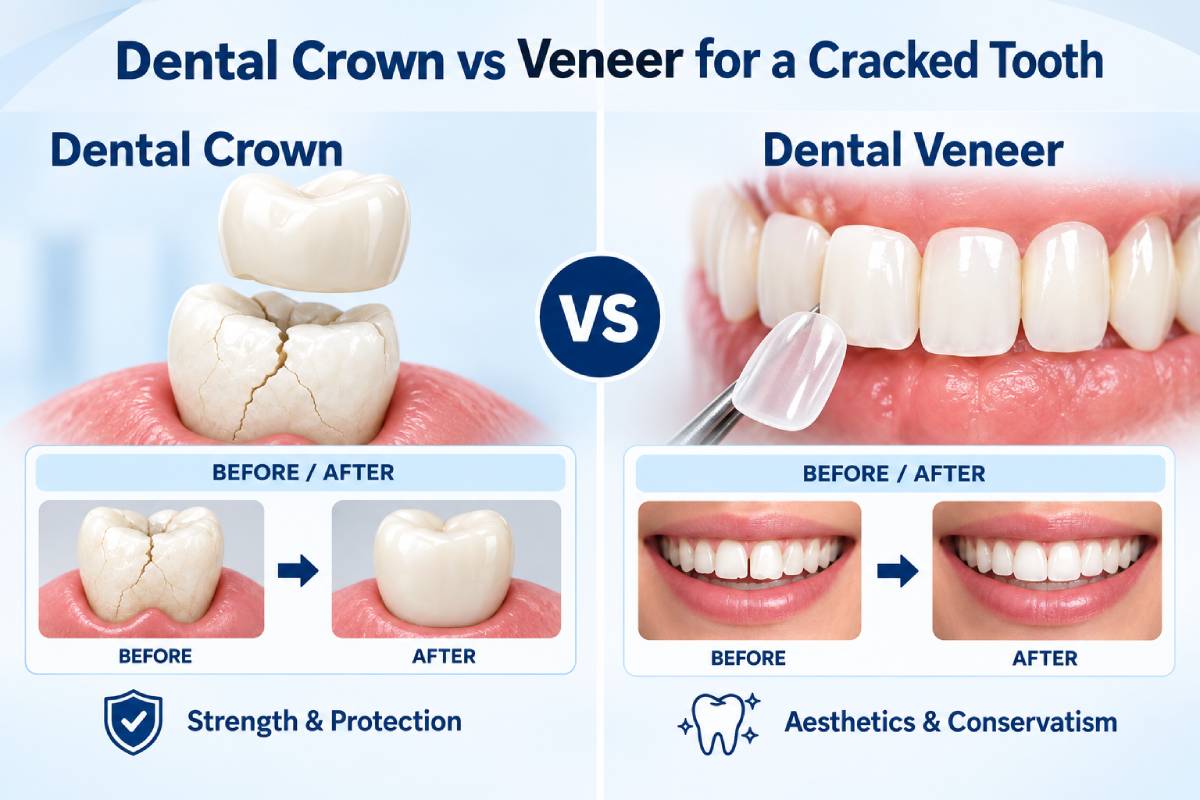
Dental Crown vs Veneer for a Cracked Tooth
A cracked tooth requires particular caution. A small superficial cosmetic crack may be managed differently from a tooth with a deeper structural fracture.
Possible treatment options can include:
- bonding
- veneer
- crown
- root canal treatment
- extraction and replacement
The treatment depends on how deep and extensive the crack is and whether the tooth can be predictably restored. Cleveland Clinic lists bonding, crowns, veneers, root canal treatment and extraction among potential treatments for different types of fractured teeth, depending on the severity and location of the damage.
Why a veneer may not always be appropriate
A veneer primarily covers the front surface. If the tooth requires structural reinforcement around a larger portion of its remaining structure, a crown may provide more appropriate coverage.
Why a crown may not always be appropriate
If the crack extends into areas where the tooth cannot be predictably restored, simply placing a crown may not solve the underlying problem.
A cracked tooth should be assessed before deciding between veneers vs crowns. For patients looking for damaged tooth treatment Dubai, professional assessment is important before choosing a restoration.
What If the Tooth Has a Root Canal?
This is another situation where patients frequently ask whether they should choose a veneer or crown.
A root canal-treated tooth may have experienced substantial loss of tooth structure from:
- decay
- previous fillings
- fracture
- access preparation
- previous restorations
The appropriate final restoration depends on how much healthy tooth remains and the functional demands placed on that tooth. Crowns are commonly used to restore root-canal-treated teeth when appropriate.
A veneer generally does not provide the same comprehensive coverage as a crown. Therefore, if a root-canal-treated tooth is significantly weakened, a veneer may not provide the protection required. A root canal history is an important factor when planning damaged tooth treatment Dubai.
Crown vs Veneer for Discoloured Teeth
Discoloration is one of the situations where the decision tree becomes particularly interesting. Before choosing either treatment, the dentist should determine why the tooth is discoloured.
Possible causes include:
- external staining
- dietary staining
- tobacco-related staining
- fluorosis
- trauma
- aging
- intrinsic discoloration
- previous dental treatment
First Option: Whitening
If the tooth is healthy and the discoloration is suitable for bleaching, professional teeth whitening may be the more conservative starting point.
Second Option: Bonding
For localized cosmetic changes, bonding may sometimes be sufficient.
Third Option: Veneers
If discoloration is significant and does not respond adequately to whitening, veneers may be considered for suitable teeth.
Fourth Option: Crown
If the tooth is also structurally compromised, a crown may be more appropriate.
Don’t use a crown to solve a colour problem when the tooth’s structure does not require a crown. For cosmetic dental treatment Dubai, identifying the cause of discoloration should come before selecting a restoration.
Crown vs Veneer for Chipped Teeth
A chipped tooth does not automatically require a veneer. The size and location of the chip matter.
Very Small Chip
The dentist may recommend simple reshaping or bonding.
Moderate Cosmetic Chip
A veneer may be considered if the tooth remains healthy and the defect is primarily aesthetic.
Large Structural Fracture
A crown may be considered if substantial tooth structure has been lost.
Deep Fracture
Root canal treatment or other intervention may be necessary before definitive restoration.
The treatment decision therefore depends on: How much tooth remains + where the damage is + whether the tooth is healthy + how much force it receives. The same-looking chip can require completely different damaged tooth treatment Dubai options in two different teeth.
Veneers vs Crowns: What About Tooth Strength?
This is where the comparison should not be reduced to “crowns are stronger.” Crowns generally provide greater coverage and are designed to restore and protect weakened teeth.
Veneers are primarily aesthetic restorations and are not intended to replace the structural function of a crown when a tooth is substantially compromised. Cleveland Clinic specifically distinguishes veneers as primarily cosmetic from crowns, which restore and strengthen damaged teeth.
However, the strength of a restoration also depends on:
- material
- thickness
- tooth preparation
- bonding
- bite
- tooth position
- laboratory fabrication
- patient’s habits
A healthy tooth restored with a properly planned veneer is a very different situation from a heavily damaged tooth receiving a crown. The right restoration is the one whose design matches the mechanical demands of the tooth.
What About Tooth Grinding or Clenching?
Bruxism or heavy clenching can significantly influence cosmetic treatment decisions.
If you frequently grind or clench your teeth, the dentist needs to consider the additional forces placed on:
- natural teeth
- veneers
- crowns
- bonding
- implants
The ADA specifically notes that patients who clench or grind their teeth, or who have certain bite conditions such as a deep overbite, may not be suitable candidates for veneers without careful assessment. This does not automatically mean: “You cannot have veneers.”
It means the dentist needs to assess:
- severity of grinding
- bite relationship
- restoration design
- protective measures
- whether another treatment sequence is more appropriate
Your bite can be just as important as your smile when deciding between veneers and crowns.
Dental Crowns vs Veneers: Which Is More Invasive?
The answer depends on what is meant by “invasive.”
Tooth Preparation
Crowns generally require more extensive tooth preparation than veneers.
Treatment Purpose
Crowns may be required because the tooth is already significantly damaged.
Therefore, the fact that a crown requires more preparation does not necessarily mean the dentist is choosing a more aggressive treatment unnecessarily.
For example:
- Weak tooth + large filling + crack → crown may protect the tooth
- Healthy tooth + cosmetic discoloration → veneer may be more conservative
- The correct comparison is therefore not: “Which treatment removes less enamel?”
- It is: “Which treatment achieves the required result while preserving as much healthy structure as reasonably possible?”
What About Dental Bonding Instead of Veneers?
This is an important addition because veneers vs crowns is not the only decision patients should consider. For certain minor cosmetic problems, dental bonding may be a more conservative option. Bonding uses tooth-coloured composite resin that is applied and shaped directly on the tooth.
It may be useful for:
- small chips
- minor shape changes
- selected small gaps
- localized cosmetic improvements
Cleveland Clinic notes that bonding may require little or no major enamel removal and can therefore be a more reversible option than porcelain veneers.
However, bonding has different durability, stain resistance, and maintenance characteristics from porcelain. If the cosmetic defect is small, ask whether bonding can achieve the desired result before committing to veneers or crowns.
What About Teeth Whitening Instead of Veneers?
If the only problem is tooth colour, whitening may be worth considering before veneers. For suitable patients, professional whitening can improve the colour of natural teeth without preparing the tooth for a restoration. However, whitening has limitations.
It cannot:
- reshape teeth
- close structural gaps
- repair chips
- correct major shape differences
- restore lost tooth structure
- It may also be less effective for certain intrinsic discoloration.
Cleveland Clinic notes that porcelain veneers can be considered when widespread discoloration does not improve with whitening.
Decision example
- Healthy teeth + general staining → whitening
- Healthy teeth + staining + shape problems → veneers may be considered
- Damaged/discoloured tooth + structural weakness → crown may be considered
Always identify the actual problem before choosing the cosmetic treatment.
What About Aligners Instead of Veneers?
This is particularly important for patients who say: “My teeth look crooked. Should I get veneers?” Not necessarily. If the main problem is tooth position, orthodontic treatment or clear aligners may sometimes address the underlying issue rather than disguising it with restorative treatment.
For example:
Crooked but Healthy Teeth
Aligners/braces may be considered.
Healthy Teeth + Shape/Colour Concerns
Veneers may be considered.
Crooked + Damaged Teeth
A combination of orthodontic and restorative treatment may sometimes be appropriate.
The sequence can matter. A dentist may recommend orthodontic alignment before cosmetic restoration to reduce the amount of tooth preparation required. Don’t use veneers simply to disguise an alignment problem when orthodontic treatment may provide a more appropriate solution.
What About a Dental Implant Instead of a Crown or Veneer?
This distinction is essential. A veneer or crown is used when there is a natural tooth that can potentially be restored.
A dental implant is used when a tooth is missing or cannot be predictably retained.
Natural Tooth Present and Healthy
Veneer may be considered for cosmetic concerns.
Natural Tooth Present but Structurally Damaged
A crown may be considered.
Natural Tooth Missing
Dental implant, bridge, or another replacement option may be considered.
Tooth Cannot Be Predictably Restored
Extraction and replacement may be required.
A dental implant therefore should not be viewed as another cosmetic alternative to a veneer. Preserving a healthy natural tooth is generally a different objective when planning damaged tooth treatment Dubai than replacing a tooth that cannot be predictably retained.
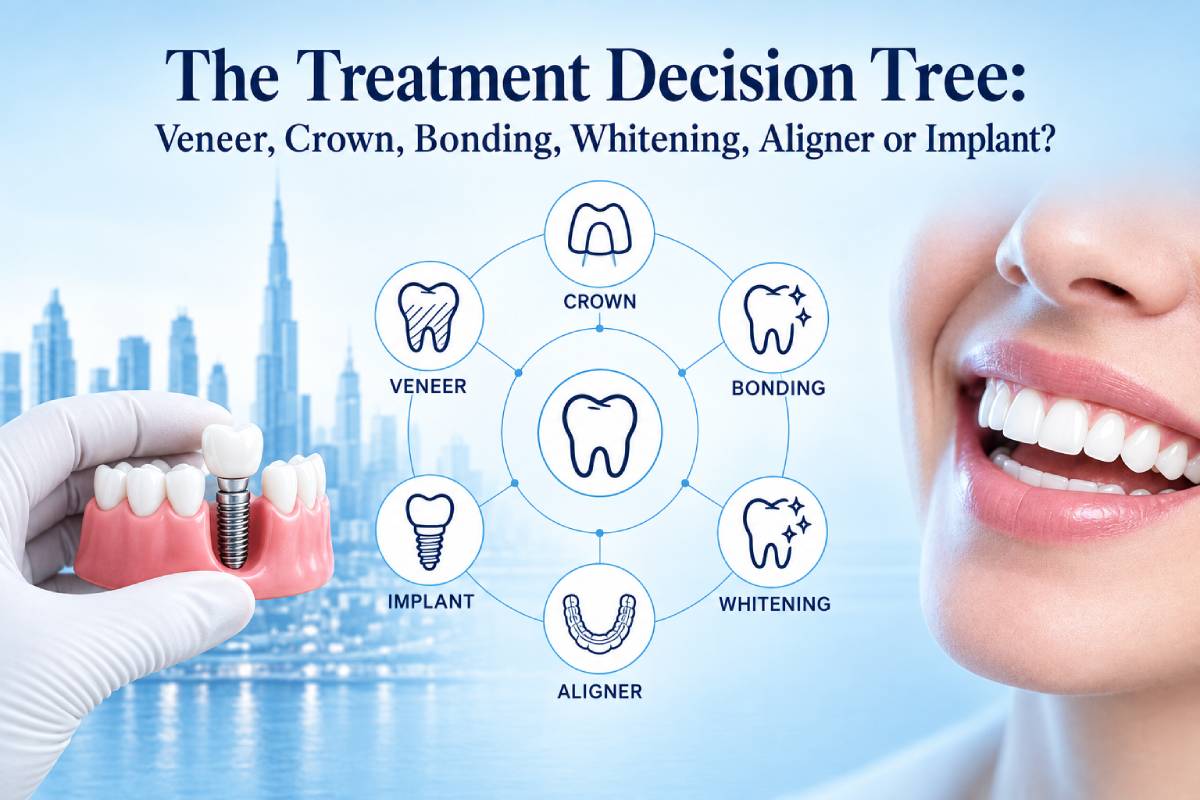
The Treatment Decision Tree: Veneer, Crown, Bonding, Whitening, Aligner or Implant?
This is the section I would make particularly strong for Google AI results because it gives a direct answer to multiple related searches.
| Main Dental Concern | Treatment That May Be Considered |
| Mild staining | Teeth whitening |
| Deep staining not responding to whitening | Veneers or other restorative option |
| Small chip | Bonding |
| Moderate cosmetic chip | Bonding or veneer |
| Major structural fracture | Crown or other restorative treatment |
| Large cavity | Filling, inlay/onlay or crown depending on damage |
| Weak tooth | Crown |
| Root-canal-treated tooth | Crown or appropriate definitive restoration |
| Small cosmetic gap | Bonding or veneer in selected cases |
| Crooked healthy teeth | Aligners/braces |
| Missing tooth | Implant, bridge or denture |
| Severely damaged non-restorable tooth | Extraction + replacement |
| Multiple cosmetic concerns | Smile makeover planning |
This table should not be interpreted as a diagnosis. The final treatment depends on examination, X-rays or other imaging when required, bite assessment, remaining tooth structure, gum health, and the patient’s goals.
When planning cosmetic dental treatment Dubai, the dentist should first identify the underlying dental concern and then select the appropriate treatment. The most appropriate cosmetic dental treatment is determined by the underlying problem, not simply by the patient’s preferred procedure.
22. Appearance: Veneers vs Crowns – Which Looks More Natural?
When patients compare veneers vs crowns, a cosmetic dentist Dubai will consider appearance, particularly for front teeth. Modern ceramic materials can provide highly aesthetic restorations, but the final appearance depends on much more than the material name. Tooth colour, translucency, surface texture, shape, gum position, neighbouring teeth and the laboratory workflow all influence the result.
For veneers, the dentist can plan the visible facial surface, tooth length, width, edge position and shade as part of a smile design. Crowns can also be highly aesthetic, but they are designed around the entire prepared tooth and must satisfy both cosmetic and functional requirements.
The American Dental Association notes that modern ceramic materials offer different combinations of strength, translucency, durability and clinical indications, so the material needs to be selected according to the individual case. A natural-looking result comes from appropriate diagnosis, tooth preparation, material selection, design and laboratory execution-not simply from choosing “veneers” or “crowns.”
Translucency: Why Does It Matter for Front Teeth?
Natural enamel allows light to interact with the tooth in a way that creates depth and translucency. This is why simply choosing a very white restoration does not necessarily create a natural-looking smile.
For porcelain veneers Dubai patients, translucency can be particularly important because veneers are often placed on visible front teeth where differences between the restoration and neighbouring natural teeth can be noticeable.
Different ceramic systems have different optical properties. The ADA notes that glass-based ceramics can offer high translucency, while different zirconia formulations balance translucency and strength differently.
A dentist may therefore select a ceramic based on:
- location of the tooth
- underlying tooth colour
- desired shade
- thickness available
- functional demands
- surrounding teeth
The “best” ceramic is not necessarily the whitest or strongest material; it is the material that fits the clinical and aesthetic requirements of the tooth.
Porcelain Veneers vs Crowns: Which Is More Durable?
Durability should be discussed carefully because neither treatment lasts forever under every circumstance.
The lifespan of a restoration depends on:
- material
- tooth condition
- preparation
- bonding or cementation
- bite
- oral hygiene
- grinding or clenching
- diet
- trauma
- regular dental maintenance
Crowns are designed to restore and protect teeth that may have lost substantial structure. Veneers are generally used on suitable teeth where the primary objective is cosmetic improvement.
The ADA’s review of indirect restorative materials shows that survival varies considerably between materials and clinical applications, reinforcing that there is no single lifespan figure that applies to every crown or veneer. Longevity depends on the restoration, the tooth, and the patient, not just whether you choose a crown or veneer.
Veneer Longevity: How Long Can Porcelain Veneers Last?
Patients searching for porcelain veneers Dubai often ask how long their veneers will last. Porcelain veneers can provide long-term cosmetic results when they are appropriately planned, bonded, and maintained. However, they can still experience complications such as chipping, fracture, debonding, or changes around the tooth.
The ADA’s review reports that veneer survival varies by material and study, with complications including chipping, debonding, and discoloration. The patient’s habits are equally important.
For example, repeatedly biting:
- ice
- hard objects
- fingernails
- very hard foods
- can increase mechanical stress.
Bruxism or clenching can also influence whether veneers are appropriate and how they should be protected. A veneer should be treated as a long-term dental restoration, not as a permanent coating that is immune to damage.
26. Dental Crown Longevity: How Long Can Crowns Last?
Dental crowns can also provide long-term service, but their performance depends on the material, tooth, bite, and maintenance.
A crown may eventually require replacement because of:
- recurrent decay
- fracture
- wear
- loss of retention
- gum changes
- changes in the supporting tooth
- trauma
The ADA’s review demonstrates that different crown materials have different reported survival rates and failure patterns. For example, metal-ceramic, lithium-disilicate, and zirconia restorations have different evidence profiles and clinical indications.
This is why it is not appropriate to promise every patient that a crown will last a particular number of years. Patients researching porcelain crowns Dubai should also consider how the crown will be maintained over time. Porcelain crowns Dubai can be long-lasting, but maintenance and the health of the underlying tooth remain critical.
Which Is More Resistant to Staining: Veneers or Crowns?
For patients primarily concerned about colour, stain resistance can be an important consideration.
Natural teeth can accumulate external stains from:
- coffee
- tea
- tobacco
- certain foods
- inadequate oral hygiene
Dental ceramics are generally resistant to many forms of surface discoloration, but the surrounding natural teeth and margins can still change over time. The ADA notes that ceramic materials are chemically inert and have low rates of surface degradation, although material and clinical conditions affect performance.
Composite materials can behave differently and may be more susceptible to discoloration. However, this does not mean a patient should choose veneers simply because they want whiter teeth. If the teeth are healthy and the concern is mainly colour, professional whitening may be a more conservative first option. Stain resistance is one consideration, not a reason by itself to place veneers or crowns.
Can You Whiten Crowns or Veneers?
This is an important consideration before cosmetic treatment. Whitening products work on natural tooth structure. They do not simply change the shade of an existing porcelain crown or veneer after it has been placed. Therefore, if you are planning a smile makeover, the dentist should discuss the desired final shade before the definitive restorations are fabricated.
For example: Existing natural teeth → whitening → select final restoration shade → veneers/crowns can be a more logical sequence than placing restorations first and trying to whiten the natural teeth afterward.
This is particularly important if only some teeth are receiving restorations. If you are considering both whitening and veneers or crowns, discuss the sequence before treatment begins.
Dental Crown vs Veneer for a Single Front Tooth
Treating one front tooth can be more challenging aesthetically than treating several teeth.
The restoration has to match:
- colour
- translucency
- width
- length
- surface texture
- neighbouring teeth
- gum level
- smile line
If the tooth is healthy and the concern is mainly cosmetic, a veneer may sometimes be appropriate. If the tooth has substantial structural damage, a crown may be more suitable.
The challenge is that a single restoration needs to blend seamlessly with the adjacent natural teeth. For a crown or veneer for front teeth, the dentist should evaluate both the structural condition and the surrounding smile before choosing the right restoration.
What If Multiple Front Teeth Need Treatment?
When several front teeth require cosmetic improvement, the dentist can plan the restorations as a group.
This can make it easier to coordinate:
- tooth proportions
- shade
- symmetry
- incisal edge position
- smile line
- tooth display
- overall aesthetics
This is where smile makeover planning becomes particularly useful. However, treating more teeth does not automatically mean better results.
A responsible cosmetic plan should identify which teeth actually require treatment and whether some natural teeth can remain untreated. A well-planned smile makeover should improve harmony while avoiding unnecessary treatment of healthy teeth.
Veneers vs Crowns for a Smile Makeover
A smile makeover may involve several procedures rather than a single restoration.
Depending on the patient’s concerns, treatment may include:
- teeth whitening
- composite bonding
- veneers
- crowns
- gum contouring
- orthodontics
- implants
- restorative treatment
For example, a patient may have healthy but uneven front teeth and benefit from orthodontic alignment followed by whitening. Another patient may have heavily worn, structurally damaged teeth requiring crowns and restorative rehabilitation.
A third patient may have healthy teeth with colour and shape concerns where veneers could be considered. For patients exploring cosmetic dental treatment Dubai, the treatment plan should be based on their individual smile, oral health and functional requirements. A smile makeover should be a treatment plan, not simply a decision to place veneers on every visible tooth.
Can You Combine Crowns and Veneers?
Yes, in some treatment plans, different restorations may be used for different teeth.
For example, a patient could have:
- crowns on structurally compromised teeth
- veneers on healthy cosmetic teeth
The dentist may coordinate the restorations so that they have compatible:
- shade
- shape
- proportions
- surface characteristics
- bite relationship
This can be particularly relevant in comprehensive cosmetic and restorative dentistry. The material selection should be based on each tooth’s clinical requirements rather than forcing every tooth into the same restoration category. A cosmetic dentist may recommend crowns for some teeth and veneers for others when the underlying conditions are different.
What Is the Cost Difference Between Dental Crowns and Veneers in Dubai?
There is no single price for either dental crowns Dubai or veneers Dubai.
The final cost can vary depending on:
- material
- number of teeth
- laboratory
- dentist experience
- complexity
- tooth preparation
- digital planning
- temporary restorations
- additional dental treatment
- whether the case is cosmetic or restorative
A porcelain veneer and a ceramic crown may have different laboratory and clinical requirements. Likewise, a straightforward single crown may be very different from a complex full-mouth restorative case.
This is why comparing two advertised prices without understanding what is included can be misleading. When comparing dental crown vs veneer costs in Dubai, compare the complete treatment plan rather than only the per-tooth price.
Why Can Two Veneers Have Very Different Prices?
Patients sometimes ask: “Why does one clinic quote AED X while another quotes significantly more?”
The price difference may reflect differences in:
Material
Different ceramic systems have different properties and costs.
Laboratory
The laboratory’s experience, technology, and fabrication process can influence the restoration.
Dentist Expertise
Complex cosmetic cases require careful diagnosis, planning, and execution.
Digital Smile Planning
Some cases involve additional digital planning, photography, scanning and mock-up stages.
Number of Appointments
The treatment workflow can differ.
Case Complexity
A straightforward veneer is different from a complex smile reconstruction.
The ADA notes that indirect restorative materials differ in physical properties, processing methods, clinical indications, aesthetics, and cost considerations.
A higher price does not automatically mean a better veneer, and a lower price does not automatically mean poor treatment. Compare what the price represents.
What Should Be Included in a Veneer or Crown Quote?
Before accepting a quotation, ask what is included.
A complete quote may need to clarify:
- consultation
- clinical examination
- photographs
- digital scans
- X-rays when required
- tooth preparation
- temporary restoration
- laboratory fabrication
- final restoration
- cementation/bonding
- adjustments
- follow-up
- maintenance instructions
For complex cases, additional procedures may be necessary before the final restoration.
For example:
- Gum treatment → restorative preparation → temporary → final crown
- Orthodontic alignment → whitening → veneer planning → final veneers
A transparent quote makes it much easier to compare two dental clinics fairly.
Are Veneers Cheaper Than Crowns?
Not necessarily. The cost of either restoration depends on the material, laboratory, dentist, number of teeth and complexity. A veneer may appear cheaper when comparing a single restoration, but a cosmetic smile makeover involving multiple veneers can become a significant investment.
Similarly, a single crown may have a different cost from a complex restorative crown requiring extensive preparation or additional treatment.
Therefore, patients should avoid assuming:
- Veneer = cheap cosmetic treatment
- Crown = expensive restorative treatment
The actual treatment plan determines the final cost. Compare treatment scope, material and inclusions rather than assuming one restoration is always cheaper.
Treatment Time: Veneers vs Crowns
Both veneers and crowns may require multiple stages depending on the case. A typical indirect restoration workflow may include:
Consultation → examination → preparation → digital impression/scan → temporary restoration → laboratory fabrication → final fitting
The exact process depends on the clinic, material, technology and complexity. Modern CAD/CAM technology can streamline some restorative workflows, while laboratory-fabricated restorations may still require multiple visits. The ADA notes that digital fabrication has increasingly changed how indirect restorations are produced and delivered.
Same-day restoration may be possible for selected cases when appropriate technology and clinical conditions are available, but it should not be assumed that every crown or veneer can or should be completed in one visit. Treatment time should be discussed as part of your individual treatment plan.
Digital Smile Design: Does It Matter for Veneers?
For a multi-tooth cosmetic case, digital planning can help communicate the proposed treatment.
Depending on the workflow, the dentist may use:
- digital photographs
- intraoral scans
- digital models
- facial analysis
- virtual tooth design
- mock-ups
The objective is to evaluate proportions and communicate the intended result before definitive treatment. However, digital software does not replace clinical judgment.
The dentist still needs to assess:
- tooth structure
- gums
- bite
- function
- hygiene
- available enamel
- restoration limitations
Digital smile design can improve planning and communication, but the clinical examination remains the foundation of treatment.
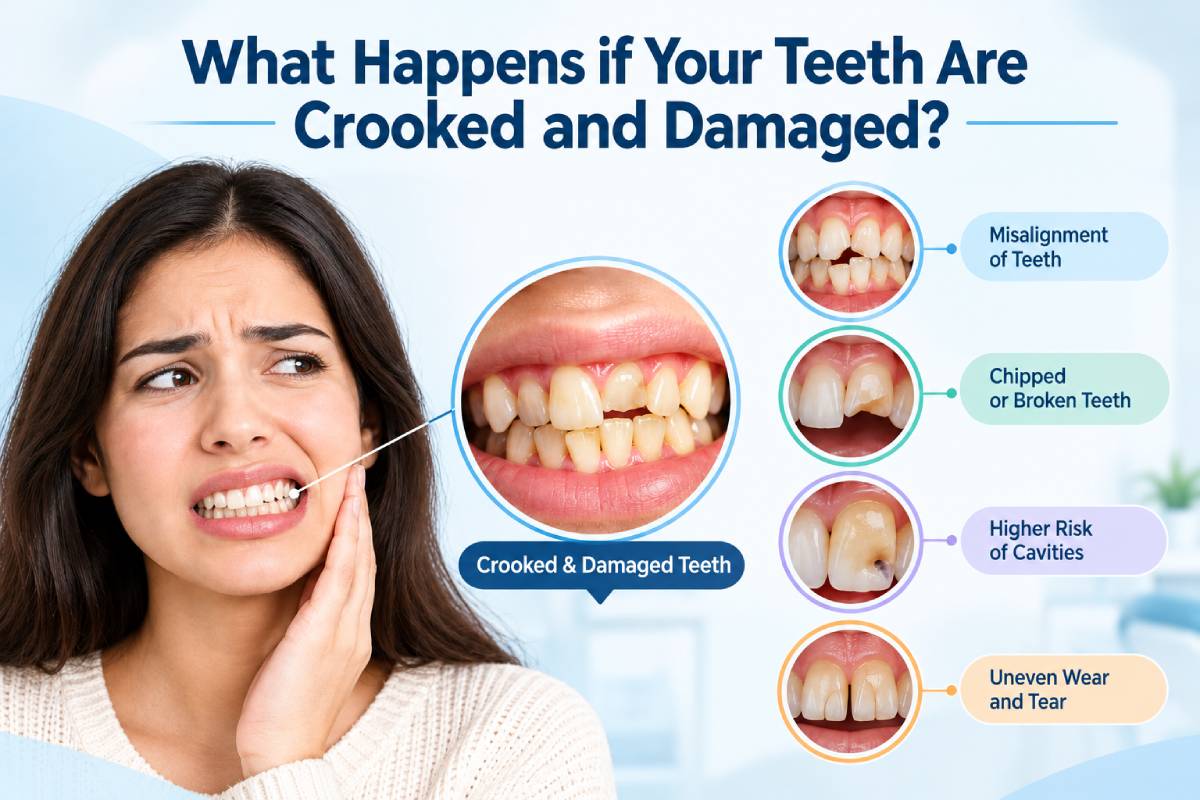
What Happens if Your Teeth Are Crooked and Damaged?
This is where treatment sequencing becomes particularly important.
Imagine a patient with:
- crowded front teeth
- worn edges
- discoloration
- several old fillings
It may be tempting to place veneers immediately. But the dentist may first recommend orthodontic alignment. Why?
Because moving the teeth into a better position may:
- reduce the amount of preparation required
- improve symmetry
- create more predictable space
- improve bite relationships
- make the final restorations more conservative
After alignment, whitening or restorative treatment may follow. Sometimes the best way to achieve a better veneer result is to treat alignment before placing veneers.
What If Your Teeth Are Healthy but You Want a Perfect Smile?
This is an important situation for cosmetic dentistry. Healthy teeth should not automatically be prepared simply because a patient wants a different smile.
The dentist should first understand:
- what you dislike about your smile
- whether the concern is colour, shape, alignment or proportion
- whether whitening could help
- whether bonding could help
- whether aligners could help
- whether a combination is appropriate
A conservative approach may sometimes achieve the desired improvement without extensive restorative treatment. For patients considering cosmetic dental treatment Dubai, the least invasive suitable option should be discussed before extensive treatment. The best cosmetic dental treatment is not necessarily the most extensive one.
How a Cosmetic Dentist Decides Between Veneers and Crowns
A comprehensive assessment may consider five major categories.
1. Tooth Structure
How much healthy tooth remains?
2. Oral Health
Is there decay, infection, or gum disease?
3. Function
What forces will the restoration experience?
4. Aesthetics
What needs to change about the tooth’s appearance?
5. Long-Term Plan
How will the tooth be maintained over time?
The material and restoration should then be selected according to the clinical situation. The ADA specifically emphasizes matching restorative materials to their physical properties, clinical indications, processing requirements, and aesthetic considerations. A cosmetic dentist Dubai should select the restoration after diagnosis, not before.
12 Questions to Ask Before Choosing Veneers or Crowns
If you are visiting a cosmetic dentist Dubai, take these questions to your consultation.
1. Is my tooth structurally healthy?
Ask whether there is decay, fracture, or significant loss of tooth structure.
2. Do I actually need a crown?
If a crown is recommended, ask what structural problem requires the additional coverage.
3. Could a veneer achieve the cosmetic objective?
This is particularly relevant for healthy front teeth.
4. Could bonding work instead?
For small chips or shape changes, bonding may be more conservative.
5. Would whitening solve the colour problem?
Do not automatically choose veneers for staining.
6. Would aligners be more appropriate?
If the primary concern is tooth position, orthodontics may be worth discussing.
7. What material are you recommending?
Ask why that material is appropriate for your tooth.
8. How much tooth preparation is required?
Ask the dentist to explain what will be removed and why.
9. How will the final smile be designed?
For multiple veneers, ask about smile planning, proportions and mock-ups.
10. What is included in the price?
Clarify laboratory work, temporary restorations, scans and follow-up.
11. What are the risks and limitations?
Every restoration has limitations and potential complications.
12. What maintenance will I need?
Ask about hygiene, night guards if appropriate, checkups and replacement considerations.
The quality of your questions can be almost as important as the treatment option you initially considered.
Red Flags When Choosing a Veneer or Crown Clinic
Be cautious if a clinic:
Promises a “Perfect Smile” Without an Examination
Every mouth is different.
Recommends Veneers for Everyone
Healthy teeth do not automatically require veneers.
Gives a Price Without Assessing Your Teeth
The actual condition of your teeth affects the treatment.
Cannot Explain the Material
You should understand what restoration is being proposed.
Does Not Discuss Bite
Occlusion can influence restoration longevity.
Avoids Discussing Limitations
A responsible consultation should explain potential risks.
Focuses Only on Before-and-After Photos
Aesthetic cases should also be evaluated for oral health and function.
A consultation with a cosmetic dentist Dubai should include both the benefits and limitations of treatment.
44. Maintenance After Veneers
Veneers do not replace normal oral hygiene.
Patients should continue:
- brushing twice daily
- cleaning between teeth
- attending regular dental examinations
- following professional hygiene recommendations
- avoiding damaging habits
If you grind or clench, your dentist may recommend additional protection such as a night guard depending on your situation.
Veneers can also develop complications over time, including chipping, debonding or discoloration, so regular monitoring remains important. The ADA’s review of indirect restorations identifies these among reported veneer complications. Good veneer maintenance protects both the restoration and the natural tooth underneath it.
Maintenance After Dental Crowns
Crowns also require normal dental care. A crowned tooth can still develop problems around or underneath the restoration if oral hygiene is poor.
Continue:
- brushing
- interdental cleaning
- regular dental examinations
- professional cleaning where recommended
- monitoring of the gum around the crown
The crown does not make the underlying tooth immune to decay or gum disease. A crown protects and restores the tooth, but it does not eliminate the need for oral hygiene.
Can a Veneer or Crown Be Replaced?
Yes, restorations may eventually require repair or replacement.
Reasons can include:
- fracture
- chipping
- debonding
- recurrent decay
- wear
- gum changes
- changes in the underlying tooth
- trauma
The need for replacement is not necessarily a sign that the original treatment failed. Dental restorations are exposed to years of chewing forces and changes in the oral environment.
The ADA’s review of restoration longevity shows that survival varies significantly according to material, restoration type, and clinical circumstances. The right expectation is long-term service with maintenance-not a promise that a restoration will never need attention.
Dental Crowns vs Veneers: Pros and Cons
| Factor | Veneers | Dental Crowns |
| Main purpose | Primarily cosmetic | Restoration + protection |
| Coverage | Mainly front surface | More extensive tooth coverage |
| Tooth preparation | Generally less than conventional crowns | Generally more extensive |
| Cosmetic potential | Excellent for suitable cases | Excellent with appropriate materials |
| Structural protection | Limited compared with crown coverage | Greater |
| Common use | Front cosmetic teeth | Damaged/weakened teeth |
| Colour correction | Yes | Yes |
| Shape correction | Yes | Yes |
| Small cosmetic chip | Often possible | Usually more than needed |
| Major structural damage | Often unsuitable | Often considered |
| Root-canal-treated tooth | Case dependent | Frequently considered |
| Maintenance | Required | Required |
| Replacement | May eventually be needed | May eventually be needed |
The table is a general guide, not a diagnosis. Material selection and clinical indications vary between individual cases.
Which Treatment Is Right for You?
A useful decision framework is:
Choose Whitening First When:
The primary concern is suitable surface or natural tooth discoloration, and the tooth otherwise has acceptable shape and structure.
Consider Bonding When:
You have a small chip, minor shape issue or selected small gap that can be corrected conservatively.
Consider Aligners When:
The main issue is tooth position, crowding or spacing rather than tooth shape.
Consider Veneers When:
The teeth are suitable and healthy enough for cosmetic restoration, but you want to address colour, shape, proportions or selected cosmetic defects.
Consider Crowns When:
The tooth is substantially damaged, weakened, heavily restored or requires greater coverage and protection.
Consider Implants When:
The tooth is missing or cannot be predictably retained.
The correct treatment is determined by the underlying problem and the long-term objective-not by which procedure is currently most popular.
Final Verdict: Dental Crowns vs Veneers in Dubai
So, which is better – veneers or crowns? There is no universal winner.
Veneers may be the better choice when:
- the tooth is structurally sound
- the main objective is cosmetic
- colour, shape or minor imperfections need improvement
- the patient wants a more conservative cosmetic restoration where clinically appropriate
Crowns may be the better choice when:
- significant tooth structure has been lost
- the tooth is weak or heavily restored
- there is substantial damage
- greater coverage and protection are required
- the tooth requires a definitive restorative solution
And sometimes neither is the best first step.
You may need:
- Whitening for colour.
- Bonding for a small chip.
- Aligners for tooth position.
- Root canal treatment for an infected tooth.
- An implant for a missing tooth.
This is why the most valuable part of the process is the diagnosis. The right cosmetic dental treatment is not necessarily the treatment that creates the fastest visual change. It is the treatment that addresses the underlying dental problem while balancing aesthetics, function, tooth preservation, and long-term maintenance.
If you are considering dental crowns Dubai or veneers Dubai, a consultation with an appropriately qualified dentist can help determine which restoration – if any – is appropriate for your teeth.
Frequently Asked Questions
Are veneers better than crowns?
Neither is universally better. Veneers are primarily cosmetic restorations for suitable teeth, while crowns provide more extensive coverage and are commonly used to restore and protect damaged or weakened teeth. The appropriate option depends on tooth structure, oral health, bite, and treatment goals.
Is a crown or veneer better for front teeth?
When deciding on a crown or veneer for front teeth, a veneer may be appropriate when the front tooth is structurally healthy but has cosmetic concerns such as discoloration, shape or minor imperfections. A crown may be more appropriate when the front tooth has significant structural damage or requires greater protection.
Are veneers more expensive than crowns in Dubai?
There is no universal price comparison. Costs depend on material, dentist experience, laboratory, number of teeth, complexity, and additional procedures. A complete quotation should be compared rather than only the per-tooth price.
Which lasts longer, crowns or veneers?
Both can provide long-term service, but longevity varies according to material, tooth condition, bite, oral hygiene, habits, and maintenance. There is no single lifespan that applies to every veneer or crown.
Do veneers damage natural teeth?
Traditional porcelain veneer treatment generally involves some enamel preparation and is considered irreversible. The amount of preparation varies by case and material.
Are crowns stronger than veneers?
Crowns provide greater coverage and are designed to restore and protect weakened teeth. However, restoration strength also depends on the material, design, preparation, bonding or cementation, and bite. The two treatments are intended for different clinical situations.
Can I get veneers instead of a crown?
Sometimes, but not when a tooth requires the structural coverage or protection provided by a crown. If a tooth is substantially weakened, cracked, or heavily restored, the dentist needs to determine whether a veneer can provide a predictable result.
Can I get a crown instead of veneers?
A crown can sometimes address cosmetic concerns, but placing a crown purely for aesthetics on an otherwise healthy tooth may involve more tooth preparation than necessary. The dentist should determine whether a more conservative option can achieve the desired result.
What is better for a chipped tooth: bonding, veneer or crown?
It depends on the size and depth of the chip and the condition of the tooth. A small cosmetic chip may be treated with bonding, a larger cosmetic defect may be considered for a veneer, while substantial structural damage may require a crown or other restorative treatment.
Should I whiten my teeth before getting veneers?
Often, discussing whitening before definitive veneers is useful because whitening changes natural tooth colour while existing restorations do not whiten in the same way. Your dentist can determine the appropriate sequence and final shade.
Can crooked teeth be treated with veneers?
Veneers can sometimes change the appearance of mildly irregular teeth, but they do not move teeth like orthodontic treatment. If the main problem is tooth position, clear aligners or braces may be a more appropriate option.
Can crowns and veneers be used together?
Yes. In some comprehensive restorative or cosmetic cases, a dentist may use crowns on structurally compromised teeth and veneers on suitable cosmetic teeth. The restorations can be coordinated for colour, shape and overall smile aesthetics.
What should I ask a cosmetic dentist before getting veneers?
Ask whether your teeth are suitable, how much preparation is required, which material is recommended and why, whether alternatives such as bonding, whitening or aligners exist, what the treatment includes, what the risks are and how the restorations will be maintained.
How do I choose a cosmetic dentist in Dubai?
Look for relevant qualifications, experience with the specific treatment, appropriate diagnostic and digital planning capabilities, clear communication, realistic treatment recommendations, and examples of comparable cases. Avoid choosing a dentist based only on promotional pricing or before-and-after photographs.