Adult Orthodontics in Dubai: Straightening Teeth in Your 30s, 40s and 50s
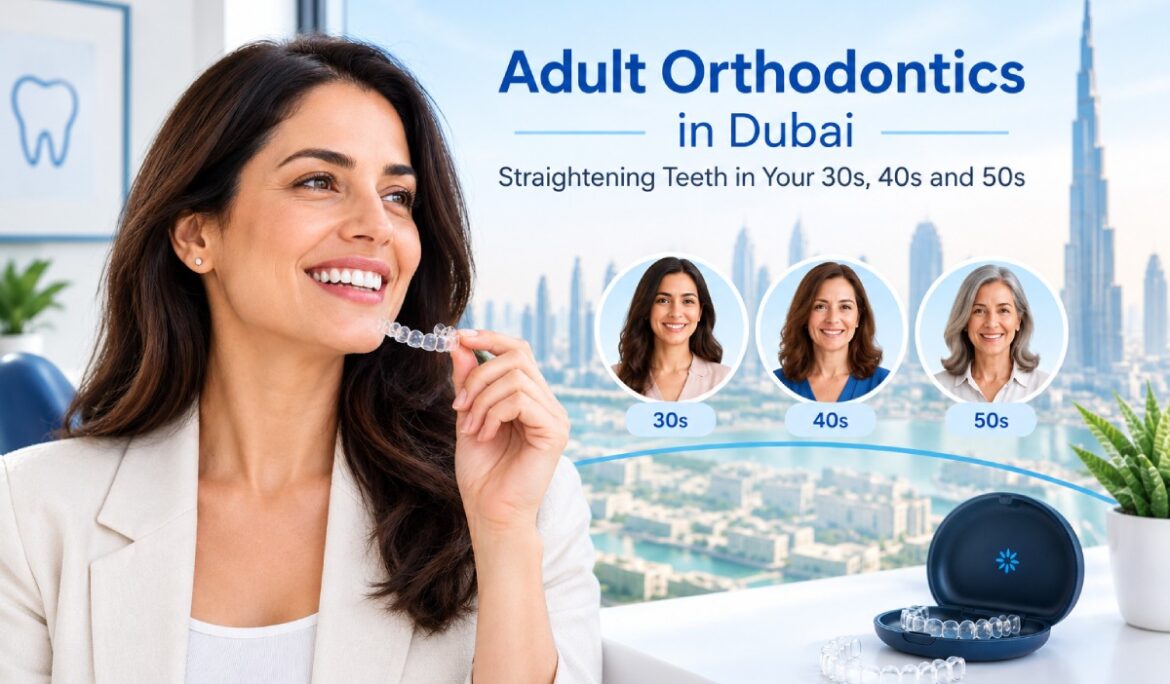
Yes. Adults can have orthodontic treatment in their 30s, 40s, 50s, and beyond. Age alone doesn’t decide whether braces or clear aligners are suitable. Before recommending treatment, the orthodontist looks at your gum health, bone support, bite, any existing crowns or implants, the tooth movements needed, and your overall oral health.
What changes after 30 isn’t whether orthodontics can work. It’s how carefully the treatment has to be planned. The biology is the same at any age: gentle, controlled pressure allows the bone around a tooth to remodel, and the tooth moves with it. Adults, though, often bring more to the chair than teenagers do.
They may have fillings and crowns, a missing tooth, an implant, some gum recession, or teeth that have shifted since braces years ago. Each of these shapes the plan. For adults considering adult orthodontics in Dubai, the same assessment applies: the bite, gums, bone support, and existing dental work must be checked before choosing an appliance.
Can You Get Braces After 30?
Yes. There’s no fixed upper age limit for orthodontic treatment. What matters is the condition of the teeth, gums, and supporting bone, the type of bite problem, and the patient’s overall oral health.
A 55-year-old with healthy periodontal tissues may be suitable for orthodontic treatment. A younger adult with active gum disease may need periodontal treatment before any tooth movement begins. An assessment for adult orthodontics in Dubai helps determine whether tooth movement can be carried out safely based on periodontal health and bone support.
Age still affects planning, even though it doesn’t rule anyone out. The sections below describe what often comes up at each stage. They’re patterns, not rules: two people of the same age can have very different mouths.
What orthodontic planning may involve in your 30s
Common reasons at this stage are crowding that has returned after teenage braces, or lower front teeth that have gradually overlapped. The orthodontist still checks gum health and bone levels. Where the teeth and gums are healthy, and the movements needed are modest, adult teeth straightening can often be done with clear aligners or discreet fixed braces.
What may change in your 40s
Some patients in their 40s have more restorations, early gum recession, or wear from clenching and grinding. When that’s the case, the orthodontist may plan together with a restorative dentist so that any new crowns or veneers are made after the teeth are in their final position, not before.
What needs more attention after 50
Braces after 50 are common, but the plan may need to account for previous bone loss, missing teeth, bridges or implants, and medical history, including medications that affect bone. Orthodontics at this stage is often one part of a wider plan, such as uprighting a tilted tooth before an implant is placed.
What Changes in Orthodontic Treatment After 30?
Choosing dental braces for adults in Dubai starts with evaluating gum health, bone support, bite alignment, and existing dental work.
| Factor | Why it matters in adults |
| Gum health | Active periodontal disease may need treatment before teeth are moved |
| Bone support | Determines how far and how quickly teeth can safely move |
| Existing crowns | May change how brackets or aligner attachments are bonded |
| Implants | Don’t move orthodontically the way natural teeth do |
| Missing teeth | May change the goals: closing a space or opening it for a replacement |
| Tooth wear | Can affect the bite and later restorative planning |
| Previous orthodontics | Relapse may be the main concern |
| Retention | Long-term retention becomes particularly important |
Why Adults Choose Orthodontic Treatment
- Relapse: teeth that were straightened in the teenage years have moved since retainers were stopped.
- Crowding over time: teeth continue to change position throughout adulthood, especially at the front of the lower jaw.
- Bite problems: an overbite, underbite, or crossbite may be chipping or wearing teeth.
- Preparing for restorative work: teeth may need repositioning before an implant, crown, or bridge.
- Appearance: usually alongside one of the reasons above.
Regardless of the reason, adult orthodontics in Dubai should be planned around the patient’s oral health, bite concerns and long-term dental goals.
What an Orthodontist Checks Before Treating an Adult
An orthodontist in Dubai begins adult treatment with a clinical assessment rather than relying on a scan and a quote alone.
At the consultation, the orthodontist usually looks at:
- Gums and periodontal health: signs of inflammation and bleeding, periodontal pockets where relevant, recession, tooth mobility, oral hygiene, and any previous gum treatment.
- Bone levels: standard orthodontic records and radiographs are chosen to suit the clinical situation. CBCT may be recommended when three-dimensional information is needed, for example for impacted teeth, complex anatomy, significant bone concerns, or planning that can’t be adequately assessed with conventional imaging.
- Existing dental work: crowns, veneers, bridges, and implants.
- The bite: including whether a problem is dental or skeletal.
- Wear and grinding: signs of clenching or bruxism.
- Medical history and medications.
Can You Have Braces With Gum Disease?
Active gum disease needs to be controlled before orthodontic tooth movement starts. Moving teeth through inflamed tissues can make existing bone loss worse. That doesn’t mean adults with a history of gum disease can’t have orthodontics.
Research on patients with reduced periodontal support shows that orthodontic treatment can be carried out once inflammation is under control, with individual planning, close coordination between the orthodontist and the periodontist, and regular periodontal maintenance during treatment.
In practice, the sequence is usually: gum disease treatment, then reassessment, then orthodontic planning, then supportive gum care throughout treatment.
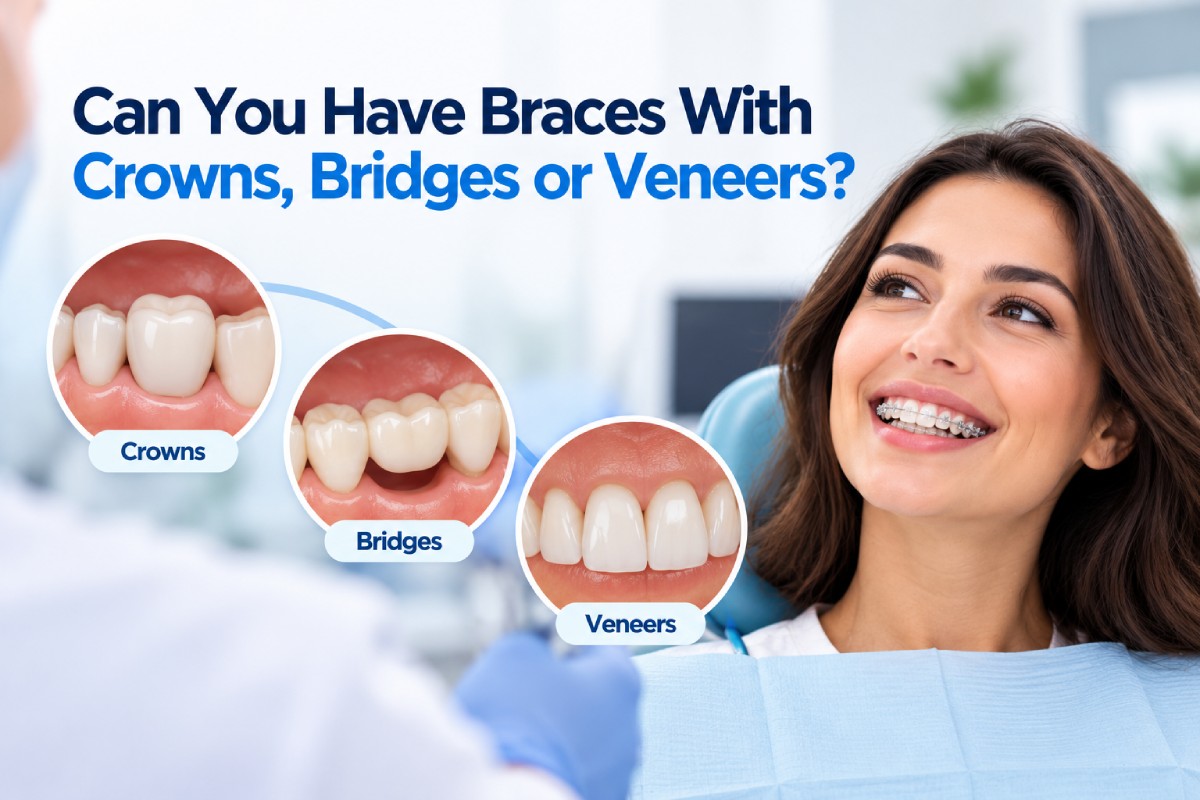
Can You Have Braces With Crowns, Bridges or Veneers?
Crowns
A crown covers a natural tooth, and the root beneath it can still move. Attaching brackets or aligner attachments to porcelain or zirconia may require modified bonding techniques, and the crown’s shape and condition are taken into account in the plan. Patients considering dental braces for adults in Dubai should discuss their crowns, veneers, and other restorations during the initial consultation.
Bridges
Existing bridges can affect orthodontic planning because they connect several teeth. The orthodontist may need to work with the restorative dentist to decide whether the bridge can stay in place or needs modification.
Veneers
Veneers also affect how attachments are bonded. If new veneers are planned for cosmetic reasons, it’s usually better to align the teeth first so the veneers can be designed around the final tooth positions.
Can You Have Orthodontic Treatment With Dental Implants or Missing Teeth?
Often, yes, but implants change the plan. An orthodontist in Dubai can assess how an existing implant or missing tooth may affect the direction and sequence of orthodontic treatment.
Dental implants don’t move through orthodontic tooth movement the way natural teeth do. Their position therefore has to be built into the treatment plan, and in selected cases an implant may provide anchorage.
In practice, an adult with an implant replacing a lower molar isn’t assessed in the same way as an adult with all natural teeth and mild lower-front crowding. The implant stays where it is, so it becomes a fixed point that the rest of the treatment is planned around. Missing teeth raise a different question: close the space, or open it for a replacement?
Orthodontics can sometimes:
- close a gap by moving neighbouring teeth;
- upright teeth that have tipped into a space;
- create the correct space and root position before a dental implant is placed.
When an implant is planned, the order of treatment matters. Placing the implant before the teeth are moved can fix it in a position that later limits what orthodontics can achieve.
Can Adults Correct Overbite, Underbite and Crossbite?
Teenagers are still growing, so some appliances can guide jaw development. Adults have finished growing. The key question is therefore whether the problem is dental (the teeth are out of position) or skeletal (the jaw bones themselves are mismatched).
- Overbite: many adult overbites are largely dental and can be improved with braces or aligners, which can reduce wear on the lower front teeth.
- Crossbite: crossbites affecting one tooth or a small group of teeth can often be corrected, which can help reduce uneven wear and localised recession.
- Underbite: mild cases may be managed with orthodontic camouflage. Where the lower jaw is significantly ahead of the upper jaw, the orthodontist may recommend an orthodontic-surgical evaluation.
Our guide to bite correction treatment explains these problems in more detail.
Braces or Clear Aligners: Choosing an Appliance as an Adult
| Factor | Clear aligners | Fixed braces |
| Visibility | Low | Higher (lower with ceramic brackets) |
| Removable | Yes | No |
| Relies on daily wear | Yes | Less so |
| Complex movements | Depends on the case | Often useful |
| Cleaning | Removed for brushing | Needs careful cleaning around brackets |
| Existing restorations | Depends on the case | Depends on the case |
Clear aligners for adults are removable and work best when worn according to the treating orthodontist’s instructions, commonly around 20–22 hours per day. Fixed orthodontic braces, in metal or tooth-coloured ceramic, don’t depend on daily wear and are often preferred for complex movements.
The appliance should follow the diagnosis, not the other way around. Invisible braces for adults may appeal to patients who prefer a less noticeable option, but suitability depends on the required tooth movements and clinical assessment.
Adult Orthodontics Decision Pathway
- Concern: “I want straighter teeth” or “my bite is changing.”
- Examination: Are the gums and supporting bone healthy?
• No: treat the periodontal problem first, then reassess.
• Yes: continue. - Diagnosis: Is the problem mainly dental or skeletal?
• Dental: braces or clear aligners may be considered.
• Skeletal: orthodontic camouflage or an orthodontic-surgical evaluation. - Existing implant, crown, or bridge? Coordinate the plan around it with the restorative dentist.
- Active treatment is completed.
- Retention keeps the result.
Adult Patient Scenarios
These are examples of how an assessment is framed, not case reports.
- 35-year-old with lower-front crowding after teenage braces: the orthodontist checks periodontal health, how much relapse has occurred and how severe the crowding is, whether aligners are suitable, and plans long-term retention.
- 45-year-old with several crowns: the orthodontist checks the condition of each crown and its bonding surface, reviews the bite, and decides with the restorative dentist whether any crowns should be replaced after alignment.
- 52-year-old with gum recession: the orthodontist assesses periodontal status and bone support, works out which tooth movements are safe, and coordinates with a periodontist before and during treatment.
- 48-year-old with one dental implant: the orthodontist looks at where the implant sits and how the neighbouring teeth are positioned, which movements are possible around the implant, and the final restorative goal.
How Long Does Adult Orthodontic Treatment Take?
Minor alignment or relapse correction may take several months. Many comprehensive orthodontic treatments take roughly 12 to 24 months, although duration varies widely from case to case. Treatment that involves gum management, implants, or jaw surgery usually takes longer because orthodontics is only one stage.
Duration depends on how much movement is needed, bone support, the appliance used, how consistently aligners are worn, and whether other dental treatment has to happen in sequence. Your orthodontist should give you an estimate for your case after the examination. For suitable cases, clear aligners for adults may be an option, although treatment duration depends on the complexity of the tooth movements.
What If You Need Gum or Restorative Treatment First?
Sequencing is often what separates a stable adult result from a compromised one.
A typical order is:
- Treat active disease: gum inflammation, decay, or infection.
- Carry out orthodontic tooth movement.
- Place final crowns, veneers, or implants in the corrected positions.
- Maintain the result with retainers and regular gum care.
When Should Adult Orthodontic Treatment Be Delayed?
Some adults aren’t ready to start straight away. That usually means delayed, not not eligible.
Treatment may be postponed when there is:
- active, uncontrolled periodontal disease;
- untreated dental infection or decay that needs priority care;
- oral hygiene that can’t currently be maintained around an appliance;
- a medical situation that needs coordination with the patient’s physician;
- an expected outcome that orthodontics can’t realistically achieve alone.
What Happens After Braces or Aligners?
Teeth continue to change position throughout adult life, including teeth that have never had treatment. That’s why retention matters as much as the active phase. Most adults are advised to use retainers long term. This may be a fixed wire bonded behind the front teeth, a removable clear retainer worn at night, or both, depending on the case.
Adult Orthodontics in Business Bay, Dubai
At Bay Avenue Dental Centre, adult orthodontics in Dubai is planned around each patient’s gum health, bone support, existing dental work, and bite rather than a preferred appliance. Treatment is led by Dr. Sachin Mudrale, Specialist Orthodontist.
Patients exploring invisible braces for adults can discuss suitable discreet treatment options with the specialist orthodontist. Where needed, he coordinates with the clinic’s periodontal, implant, and restorative dentists so that each stage happens in the right order. Bay Avenue Dental Centre is a multi-specialty dental clinic at The Regal Tower, Office 1701, Business Bay, Dubai.
Questions to Ask Before Starting Adult Orthodontics
- Are my gums and bone healthy enough to start now?
- Is my problem dental, skeletal, or both?
- How will my crowns, bridge, or implant affect the plan?
- Do I need any gum or restorative treatment first?
- Would aligners or fixed braces suit my case better, and why?
- What is a realistic treatment time for me?
- What kind of retainer will I need, and for how long?
- What happens if my teeth don’t respond as expected?
Frequently Asked Questions
Can you get braces after 30?
Yes. Adult orthodontics in Dubai may be suitable after 30, provided the teeth, gums and supporting bone are healthy enough and the bite problem can be treated predictably
Can I get braces after 40?
Yes. In your 40s, the orthodontist pays particular attention to existing restorations, tooth wear and early gum recession, and may plan together with a restorative dentist.
Can you get braces at 60?
Yes. Age alone doesn’t prevent orthodontic treatment. The orthodontist needs to evaluate periodontal health, bone support, dental condition, medical history, and the specific tooth movements required.
Can I get clear aligners after 50?
Often, yes, if the gums are stable and the movements needed are suitable for aligners. Clear aligners for adults work the same way at any age, but they depend on consistent daily wear.
Can I get braces if I have gum disease?
Active gum disease must be treated and controlled first. Once the gums are stable, orthodontic treatment is often possible, with regular periodontal maintenance during treatment.
Can I straighten teeth if I have dental crowns?
Your orthodontist in Dubai can coordinate with your restorative dentist when crowns or other dental work affect treatment planning.
Can orthodontic treatment be done after a dental implant?
Yes, but the implant won’t move like a natural tooth. Its position becomes a fixed point in the plan. Where treatment is planned in advance, orthodontics is often completed before the implant is placed.
Can an adult underbite be fixed without surgery?
Mild underbites can often be managed with orthodontic camouflage. Where the jaws are significantly mismatched, an orthodontic-surgical approach may be recommended.
How long do adult braces take?
Minor corrections may take several months. Many comprehensive treatments take roughly 12 to 24 months, depending on the case.
Will I need a retainer after adult orthodontic treatment?
Yes. Teeth tend to change position throughout life, so most adults are advised to use retainers long term.
Considering adult orthodontics in Dubai? A consultation can assess your gums, bone support, bite, and existing dental work before recommending suitable treatment, including braces or aligners.
Book an orthodontic consultation at Bay Avenue Dental Centre, Business Bay, Dubai · +971 55 146 5512 · +971 4 277 0247 · info@bayavenuedc.com