Jaw Correction Braces: How Orthodontics Improves Bite and Facial Balance
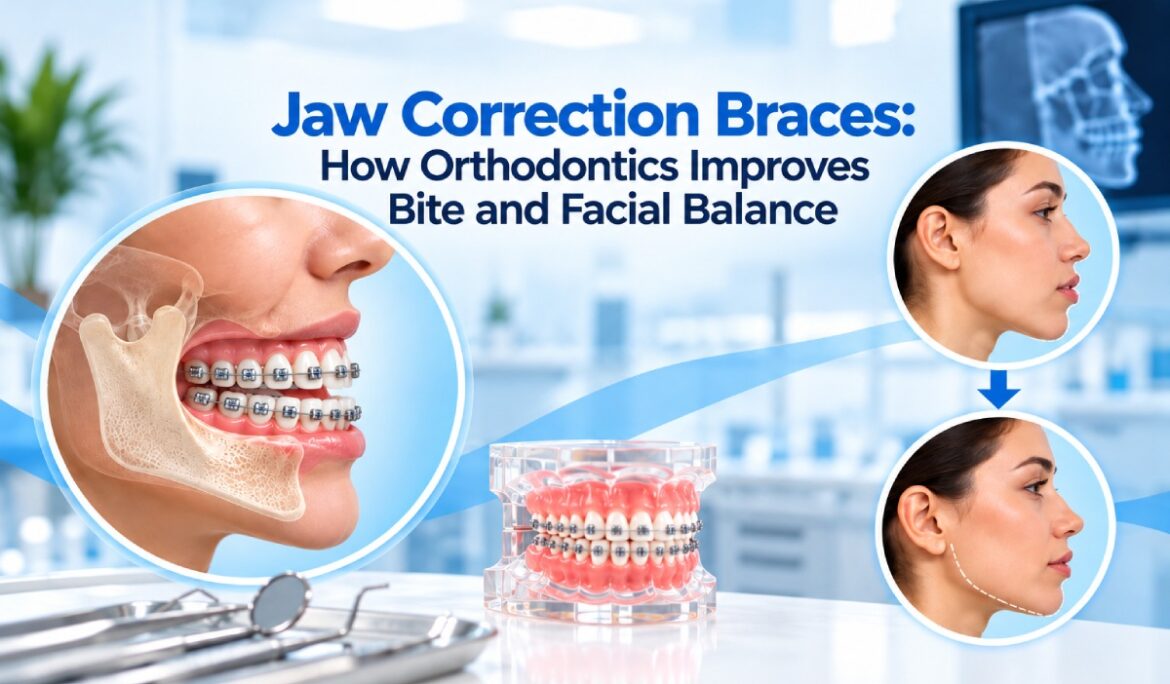
When people search for orthodontic jaw correction, they are often trying to understand a problem that is more complicated than crooked teeth. A bite can feel uncomfortable, teeth may not meet properly, the lower jaw may appear too far forward or backward, or the face may look asymmetrical when viewed from the front or side. In some cases, the problem is primarily caused by the position of the teeth. In others, the relationship between the upper and lower jaws is the main issue.
That distinction matters because braces move teeth, while significant skeletal jaw discrepancies may require orthopedic treatment during growth or jaw correction surgery in adults. Orthodontic treatment can improve how the upper and lower teeth fit together, correct overbite and underbite, create space for crowded teeth, close unwanted gaps, and improve the relationship between the dental arches. When treatment is appropriately planned, these changes can also influence the appearance of the smile and lower facial profile.
For patients considering treatment in Dubai, the first step should therefore be a proper orthodontic assessment rather than choosing braces based only on appearance or price. This guide explains what orthodontic treatment for jaw alignment in Dubai can and cannot do, the different types of jaw and bite problems, when braces or clear aligners may be appropriate, when surgery may be considered, how treatment differs between children and adults, and what to expect during the process.
What Are Jaw Correction Braces?
Jaw correction braces are orthodontic appliances used to move teeth and improve the relationship between the upper and lower dental arches, helping correct bite problems associated with tooth or jaw alignment. They can improve dental alignment and, in growing patients, certain jaw discrepancies may also be influenced by growth-modification appliances. Significant skeletal jaw discrepancies in adults may require orthognathic surgery rather than braces alone.
This distinction is important because the phrase “jaw correction braces” can mean different things to different patients.
Braces are attached to the teeth and apply controlled forces to move individual teeth or groups of teeth. Through orthodontic treatment, the dentist or orthodontist can change tooth inclination, rotation, spacing, and position within the supporting bone.
However, conventional braces do not simply “move the jaw into position.” If the underlying problem is primarily skeletal, for example, the lower jaw is significantly positioned ahead of the upper jaw, braces alone may not be sufficient, particularly once facial growth is complete.
Dental alignment versus skeletal jaw correction
Consider two patients with an underbite.
Patient A:
The jaw relationship is relatively normal, but the front teeth are positioned incorrectly. Orthodontic treatment may be capable of correcting much of the problem by moving the teeth.
Patient B:
The lower jaw is significantly larger or positioned substantially forward relative to the upper jaw. The problem is skeletal as well as dental. In an adult, orthodontics may prepare the teeth for corrective jaw surgery rather than solving the skeletal discrepancy by itself.
This is why a specialist assessment is essential before deciding that braces are the appropriate treatment.
Why Jaw Alignment and Bite Matter
Orthodontics is not simply about making teeth appear straight. The upper and lower teeth need to work together during everyday functions such as biting, chewing, and speaking. When the bite is significantly altered, some teeth may receive more force than others. Depending on the individual case, abnormal tooth contacts can contribute to uneven wear, difficulty cleaning certain areas, or discomfort associated with the jaw and surrounding structures.
Poor alignment can also make oral hygiene more difficult. For example, crowded teeth can create overlapping areas where a toothbrush or interdental cleaner may be harder to use effectively. This does not mean that every crooked tooth will cause disease, but alignment can be one factor affecting a patient’s ability to maintain good oral hygiene.
Bite correction may address several objectives at once
A comprehensive orthodontic plan may aim to:
- Align crowded or rotated teeth
- Close excessive spaces
- Correct overbite
- Improve an underbite
- Correct crossbite
- Improve the relationship between the dental arches
- Create a more stable bite
- Improve tooth function
- Improve smile appearance
- Prepare teeth for restorative or surgical treatment when required
The appropriate goal depends on the patient’s diagnosis rather than simply achieving perfectly straight front teeth.
What Problems Can Dentist Jaw Alignment Treatment Address?
The term “jaw correction” covers several different bite and alignment problems.
Overbite
An overbite occurs when the upper front teeth vertically overlap the lower front teeth more than expected. A mild amount of vertical overlap is normal. The concern arises when the overlap is excessive or associated with other dental or skeletal problems.
Treatment may involve moving the front teeth, controlling their vertical position and addressing the relationship between the upper and lower arches. In growing patients, the orthodontic approach may also consider jaw growth and the developing facial structure.
Underbite
An underbite occurs when the lower front teeth sit in front of the upper front teeth when the patient bites together. The cause can vary.
It may result from:
- Lower dental arch position
- Upper dental arch position
- Tooth inclination
- A combination of dental and skeletal factors
- A discrepancy in upper and lower jaw growth
This is one of the clearest examples of why diagnosis matters.
A mild dental underbite may respond well to orthodontic tooth movement, while a significant skeletal Class III relationship may require a different treatment strategy. In adults with substantial skeletal discrepancy, orthognathic jaw correction surgery may be discussed alongside orthodontic treatment.
Crossbite and Jaw Alignment
A crossbite occurs when one or more upper teeth bite inside the corresponding lower teeth instead of outside them.
It can affect individual teeth or larger portions of the dental arch. Some crossbites are primarily dental, while others may be associated with the width or position of the upper or lower jaw.
Why early assessment can matter
In a growing child, certain skeletal or arch-width problems may be more responsive to orthopedic treatment because the facial bones are still developing. That does not mean every child with a crossbite requires early intervention.
The purpose of an orthodontic evaluation is to determine:
- What is causing the crossbite?
- Is it dental or skeletal?
- Is growth still occurring?
- Is treatment needed now?
- Could waiting make correction more complicated?
This is one reason parents should not assume that orthodontic treatment should automatically begin as soon as a problem is noticed.
Crowding and Dental Arch Problems
Crowding occurs when there is insufficient space for teeth to align normally within the dental arch.
A patient may notice:
- Overlapping teeth
- Rotated teeth
- Teeth erupting behind or in front of others
- Difficulty flossing
- An uneven smile
Crowding can be mild, moderate or severe.
Treatment planning depends on factors such as:
- Available arch space
- Tooth size
- Facial profile
- Jaw width
- Existing restorations
- Gum health
- Patient age
- Skeletal relationships
In some cases, orthodontic expansion or tooth movement can create sufficient space. In others, extraction may be considered. Extraction should never be presented as an automatic part of braces treatment. It is a case-specific decision based on the patient’s anatomy, bite, facial profile, and treatment objectives.
Spacing and Gaps Between Teeth
The opposite problem is excessive spacing.
Spaces can occur because of:
- Naturally small teeth
- Missing teeth
- Tooth-size discrepancies
- Jaw size
- Habits
- Gum or bone changes
- A prominent frenum in selected cases
Braces or clear aligners can often move teeth together to close appropriate spaces. However, simply closing a gap does not always solve the underlying issue. For example, if the teeth are disproportionately small relative to the available space, closing everything orthodontically may produce undesirable tooth proportions.
In selected cosmetic cases, orthodontics may therefore be combined with restorative dentistry such as bonding or veneers after alignment. This is where treatment planning between orthodontics and cosmetic dentistry becomes valuable.
What Causes Jaw Misalignment?
Jaw and bite problems do not have one universal cause. A patient’s final bite can reflect several interacting factors.
Genetics
The size and relationship of the upper and lower jaws can have a hereditary component. Family patterns of prominent lower jaws, small lower jaws, crowding, or certain bite relationships can sometimes be observed.
Growth and development
The upper and lower jaws do not necessarily grow at exactly the same rate or in the same direction. A bite that appears relatively normal during childhood can change as the jaws develop.
Tooth position
Sometimes the jaws are reasonably well related, but individual teeth are positioned incorrectly. This is primarily a dental alignment problem.
Habits
Certain prolonged childhood habits can influence dental development, although the effect depends on factors such as duration, intensity and the child’s underlying growth pattern.
Missing or early-lost teeth
Premature loss of primary or permanent teeth can affect available space and the eruption path of neighbouring teeth.
Trauma and other conditions
In some cases, injury or developmental conditions can influence jaw or dental relationships. Because several factors can contribute simultaneously, a visual examination alone is not enough to determine the cause.
How Does an Orthodontist Diagnose a Jaw Alignment Problem?
A proper orthodontist for jaw correction does not begin treatment simply by choosing between metal braces and clear aligners. Diagnosis comes first.
Step 1: Medical and dental history
The orthodontist may ask about:
- Previous orthodontic treatment
- Tooth extraction
- Jaw discomfort
- Dental trauma
- Family history
- Oral habits
- Existing dental restorations
- Previous dental or surgical treatment
Step 2: Clinical examination
The dentist or orthodontist examines the:
- Teeth
- Gums
- Dental arches
- Bite
- Jaw movement
- Facial proportions
- Tooth wear
- Midline
- Profile
Step 3: Photographs
Facial and intraoral photographs can help document the starting position and evaluate changes throughout treatment.
Step 4: Digital scanning
An intraoral scanner can create a digital representation of the teeth and dental arches. This can assist with treatment planning and, where appropriate, aligner design.
Step 5: X-rays
Depending on the case, orthodontic radiographs can provide information about tooth roots, jaw relationships and developing teeth.
Step 6: Three-dimensional imaging
CBCT is not required for every orthodontic patient.
When clinically indicated, however, three-dimensional imaging can provide additional information about bone, impacted teeth, airway-related anatomy, and complex dental or skeletal structures. The important point is that technology should be selected according to the diagnostic question, rather than because a clinic simply advertises having advanced equipment.
How Orthodontic Braces Actually Move Teeth?
Braces work through controlled orthodontic forces. Brackets are attached to teeth and connected by an orthodontic archwire. The wire and other components apply forces that encourage teeth to move gradually through the supporting tissues. The process involves biological remodeling around the tooth. This is why orthodontic treatment cannot safely move teeth from one position to another overnight.
Different movements require different mechanics
An orthodontist may need to:
- Rotate a tooth
- Tip a tooth
- Move it forward or backward
- Intrude or extrude it vertically
- Close a space
- Open a space
- Coordinate upper and lower arches
Rubber elastics may also be used in selected cases to help modify the relationship between the upper and lower teeth. For more significant bite problems, additional orthodontic mechanics or appliances may be required. This is another reason why the treatment duration and appliance selection cannot be determined accurately from a photograph alone.
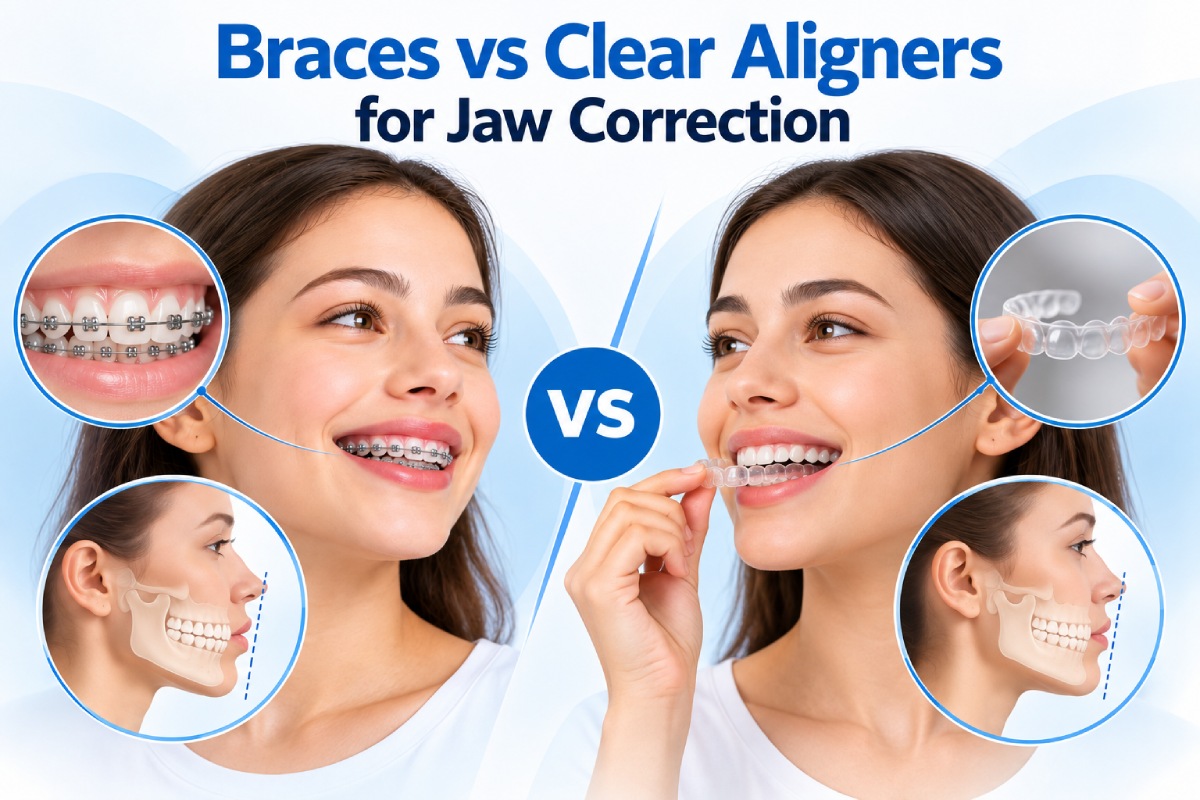
Braces vs Clear Aligners for Jaw Correction
Patients frequently ask whether clear aligners can replace braces for jaw correction. The answer is case-dependent. Both systems can move teeth, but their capabilities, mechanics, and suitability vary depending on the diagnosis.
Metal braces
Metal braces remain a versatile option for many orthodontic problems. They are fixed to the teeth, which means treatment does not depend on the patient remembering to wear an appliance. This can be particularly useful when substantial or precise tooth movement is required. They can also be combined with elastics and other orthodontic components when indicated.
Clear aligners
Clear aligners use a series of removable trays to progressively move teeth according to a digital treatment plan. They are attractive to many adults because they are relatively discreet and can be removed for eating and oral hygiene.
However, removable treatment introduces a major variable:
patient compliance.
If the aligners are not worn as instructed, planned tooth movement may not occur as expected.
Which is better?
There is no universal winner.
The appropriate choice depends on:
- Bite problem
- Severity of crowding
- Tooth movement required
- Skeletal relationship
- Patient age
- Compliance
- Oral hygiene
- Treatment objectives
- Orthodontist’s assessment
For a patient with a primarily dental alignment problem, clear aligners may be a suitable option. For a complex skeletal problem, the discussion may instead involve comprehensive orthodontics and, in adults, possible surgical treatment.
Can Braces Actually Correct the Jaw?
This is one of the most important questions to answer clearly. Braces can correct the position of teeth and improve the bite, but conventional braces cannot independently reposition a fully grown adult jaw in the same way that jaw surgery can.
In children and adolescents who are still growing, selected orthodontic or orthopedic appliances may influence jaw development and the relationship between the jaws. In adults, however, significant skeletal discrepancies may require a combination of orthodontics and orthognathic surgery.
Three different situations
Dental problem:
Teeth are incorrectly positioned, but the jaw relationship is acceptable.
→ Orthodontic treatment may be sufficient.
Growth-related jaw discrepancy:
The child is still developing, and the jaw relationship may be influenced through appropriate growth-modification treatment.
→ Orthodontic/orthopedic treatment may be considered.
Significant adult skeletal discrepancy:
The jaw bones themselves are substantially mismatched.
→ Orthodontics may be combined with corrective jaw surgery.
This distinction should be explained to patients before treatment begins.
Jaw Correction Surgery in Dubai: When May It Be Considered?
Patients searching for jaw correction surgery Dubai are often referring to orthognathic surgery. Orthognathic surgery is used to correct significant skeletal discrepancies involving the upper jaw, lower jaw, or both. For patients considering jaw correction surgery Dubai, a detailed orthodontic and surgical assessment helps determine whether surgery is appropriate. It is generally considered when the jaw relationship cannot be adequately corrected with orthodontic tooth movement alone.
Potential indications can include significant:
- Underbite
- Overbite
- Open bite
- Facial asymmetry
- Jaw size discrepancy
- Skeletal malocclusion
The exact indication depends on the patient’s clinical findings. Patients researching jaw correction surgery Dubai should discuss their diagnosis, surgical eligibility, and expected treatment sequence with an experienced orthodontic-surgical team.
Orthodontics and surgery often work together
Corrective jaw surgery is not necessarily an alternative to braces. In many cases, orthodontic treatment is used before and after surgery. The general sequence can involve: Diagnosis → orthodontic preparation → surgery → orthodontic finishing → retention
The teeth may initially appear less aesthetically aligned during preparation because the orthodontist is positioning them correctly relative to their respective jaws before the surgical correction. This is why patients considering surgery should seek assessment from clinicians experienced in managing orthodontic-surgical cases.
Jaw Correction for Children vs Adults
Age is one of the most important variables in orthodontic treatment.
Children
Children are still experiencing facial growth, which can provide opportunities for certain types of orthopedic or growth-modification treatment.
An early orthodontic assessment can identify:
- Developing crossbite
- Significant crowding
- Eruption problems
- Jaw growth discrepancies
- Oral habits
- Missing or impacted teeth
- Severe overbite or underbite
Early assessment does not mean every child needs braces immediately. Sometimes the best recommendation is simply monitoring growth and returning at a specific stage.
Teenagers
Teenage years are often an important period for comprehensive orthodontic treatment because many permanent teeth have erupted and facial growth may still be occurring. Treatment can address both dental alignment and, in selected cases, growth-related bite issues.
Adults
Adults can receive orthodontic treatment successfully, but the treatment approach is different when facial growth has finished. Braces and aligners can move teeth, but significant skeletal jaw discrepancies may require surgical consultation.
Adults also require assessment of:
- Gum health
- Bone support
- Existing crowns
- Bridges
- Implants
- Root canal-treated teeth
- Tooth wear
- Previous orthodontic treatment
Therefore, adult orthodontic treatment should begin with a complete dental and periodontal assessment.
How Long Does Orthodontic Treatment Take?
There is no single treatment duration that applies to every patient. The timeline depends on the diagnosis and the amount of tooth movement required.
Mild alignment problems
Simple spacing or mild crowding may require a shorter treatment period than complex bite correction.
Moderate cases
Cases involving multiple teeth, more significant crowding, or bite correction generally require more time.
Complex cases
Treatment may take considerably longer when there is:
- Severe crowding
- Significant bite discrepancy
- Impacted teeth
- Skeletal jaw problems
- Missing teeth
- Previous orthodontic treatment
- Surgical planning
- Extensive tooth movement
For patients undergoing orthognathic surgery, the overall treatment journey can be substantially longer than routine orthodontic alignment because treatment may involve orthodontic preparation, surgery, and post-surgical finishing.
Why treatment estimates can change
Orthodontic treatment is biologically driven. The actual rate of movement varies between individuals.
Treatment can also be extended if:
- Appointments are missed
- Appliances break repeatedly
- Aligners are not worn as instructed
- Oral hygiene problems interrupt treatment
- Additional tooth movement becomes necessary
- Teeth respond differently than anticipated
A good orthodontist should therefore provide an estimated timeline rather than promise an exact completion date.
What Can Patients Expect During Jaw Correction Treatment?
Once the diagnosis and treatment plan are established, treatment usually progresses through several stages.
Initial alignment
The first stage may focus on correcting rotations, relieving crowding and beginning to coordinate the dental arches.
Space management
Depending on the case, spaces may be opened or closed to establish the desired tooth positions.
Bite correction
The orthodontist then focuses on the relationship between the upper and lower teeth. Elastics or other mechanics may be introduced where necessary.
Finishing
Near the end of treatment, small adjustments are made to improve tooth contacts, alignment, and aesthetics.
Retention
Braces or aligners are eventually removed, but treatment does not simply end there. Retention is necessary because teeth can shift after orthodontic treatment. Retainers help maintain the corrected positions and are an important part of long-term orthodontic care.
Can Jaw Correction Improve Facial Balance?
This depends heavily on what is causing the imbalance. When teeth are significantly misaligned, correcting their position can improve the appearance of the smile and sometimes influence the visible relationship between the lips and teeth. In growing patients, treatment that modifies dental and, where appropriate, skeletal relationships can have broader effects on facial development. However, braces should not be marketed as a guaranteed method for changing an adult’s jaw shape.
Facial balance depends on several structures
Appearance is influenced by:
- Upper jaw position
- Lower jaw position
- Chin position
- Tooth inclination
- Lip position
- Facial soft tissues
- Vertical facial proportions
- Nasal and surrounding structures
Orthodontic treatment can influence some of these relationships indirectly through tooth movement and bite correction. A dentist jaw alignment assessment can help determine whether the concern is related mainly to tooth position, bite alignment, or the underlying jaw structure. Significant skeletal changes, however, may require orthognathic surgery. A responsible treatment plan should explain what orthodontics is realistically expected to change before treatment begins.
When Should You See an Orthodontist for Jaw Correction?
You should consider an orthodontic assessment if you notice:
- Teeth that do not meet comfortably
- Significant overbite
- Underbite
- Crossbite
- Open bite
- Difficulty chewing
- Severe crowding
- Persistent spacing
- Teeth erupting in unusual positions
- Facial asymmetry associated with the bite
- Jaw growth concerns in a child
- Previous orthodontic treatment with relapse
Parents should also consider an orthodontic evaluation when a child’s permanent teeth are erupting unusually, or the bite appears significantly different from that of other children. An assessment does not automatically lead to braces. In many cases, the most useful outcome is simply understanding whether treatment is required now, later, or not at all.
How to Choose an Orthodontist for Jaw Correction in Dubai
Because jaw correction can involve more than straightforward tooth alignment, choosing the right clinician matters.
Look for orthodontic expertise
Ask about the dentist’s orthodontic qualifications and experience treating cases similar to yours.
Ask whether the problem is dental or skeletal
This is perhaps the most important question. You should understand whether your issue is primarily caused by tooth position, jaw position, or both. A dentist jaw alignment evaluation should also consider your bite, facial proportions, and overall dental health.
Ask what imaging is required
The orthodontist should explain why particular X-rays or scans are recommended.
Ask about treatment alternatives
Depending on the case, alternatives may include:
- Metal braces
- Ceramic braces
- Clear aligners
- Functional or orthopedic appliances
- Observation
- Orthodontics combined with surgery
Ask about realistic outcomes
A good consultation should explain what can be improved and what cannot.
Ask about retention
The treatment plan should include a strategy for maintaining the result after active orthodontics.
Braces vs Clear Aligners for Jaw and Bite Correction: Which Is Better?
One of the most common questions patients ask after being told they need orthodontic treatment is whether they should choose traditional braces or clear aligners. The answer cannot be based only on appearance. The right appliance depends on what needs to move, how much movement is required, how predictable that movement needs to be, and how consistently the patient can follow the treatment plan.
Both braces and aligners can correct many forms of dental malocclusion. However, a significant skeletal jaw discrepancy is a different problem. Neither appliance should be presented as a universal substitute for surgical correction when the underlying issue is primarily skeletal.
Metal braces for complex bite correction
Metal braces remain one of the most versatile orthodontic systems because the appliance is fixed to the teeth throughout treatment. This allows the orthodontist to apply controlled forces to individual teeth and coordinate the upper and lower arches over time. Braces can also be used with elastics and other mechanics when additional bite correction is required For patients with significant crowding, rotations, complex tooth movement, or certain bite problems, fixed appliances may offer advantages in treatment control.
Clear aligners for selected cases
Clear aligners move teeth using a sequence of removable trays. They can be highly effective for many alignment and bite problems when the treatment plan is appropriate, and the patient follows the prescribed wearing schedule.
Their main practical advantage is discretion. They can also be removed for eating and brushing. However, removable appliances require cooperation. Wearing aligners inconsistently can affect tracking and extend treatment.
The important question is not “Which looks better?” The better question is: Which orthodontic system can predictably achieve the required tooth movement and bite correction for this specific diagnosis? An orthodontist should evaluate the severity of the problem before recommending an appliance.
Functional and Growth-Modification Appliances: Why Children Are Different
When a child is still growing, orthodontic treatment can involve more than simply moving teeth. Certain orthodontic appliances are designed to influence the relationship between the dental arches and, in selected patients, guide aspects of jaw development during growth. This is fundamentally different from conventional braces.
Examples of situations where early intervention may be considered
An orthodontist may evaluate a child for:
- Developing underbite
- Significant overbite
- Crossbite
- Narrow upper dental arch
- Functional shifts of the lower jaw
- Severe crowding
- Abnormal eruption patterns
- Certain jaw-growth discrepancies
The timing is important because growth potential is a major factor in deciding whether a growth-modification approach is appropriate.
Does every child with a bite problem need early treatment?
No. Some orthodontic problems are better treated later, when more permanent teeth have erupted. In other cases, monitoring may be preferable to immediate intervention. The purpose of an early orthodontic consultation is therefore not necessarily to start braces. It is to determine whether there is a time-sensitive problem that would benefit from intervention or monitoring.
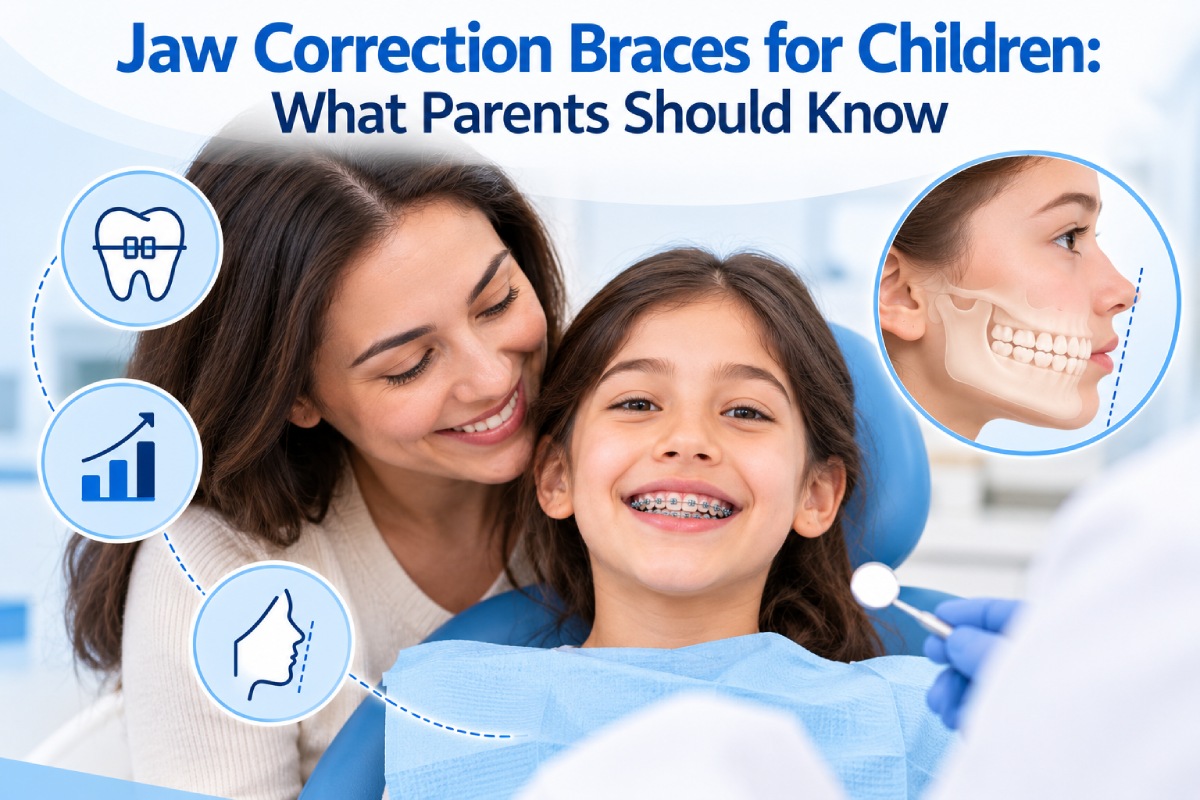
Jaw Correction Braces for Children: What Parents Should Know
Parents often notice an unusual bite before the child complains about it.
A child may have:
- Upper teeth that protrude significantly
- Lower teeth that sit ahead of the upper teeth
- Teeth that do not meet correctly
- A noticeable crossbite
- Severe crowding
- Difficulty biting certain foods
- Teeth erupting behind other teeth
These signs do not automatically indicate a serious jaw disorder, but they justify professional assessment.
Why early diagnosis can be valuable
An orthodontist can determine whether the problem is:
- Dental: The teeth are positioned incorrectly.
- Skeletal: The relationship or growth of the jaws is contributing to the problem.
- Functional: The child’s bite causes the lower jaw to shift when closing.
- Combined: Several factors are present simultaneously.
This classification influences treatment timing. A child with a developing skeletal discrepancy may have treatment options that become less predictable once facial growth is complete. That is one reason parents searching for a pediatric dentist and orthodontist near me should distinguish routine children’s dentistry from specialist orthodontic assessment when the concern specifically involves bite or jaw development.
Adult Jaw Correction: Why Treatment Planning Is More Complex
Adults can undergo successful orthodontic treatment at virtually any stage of adulthood when their teeth and supporting tissues are suitable for treatment. But adult treatment has additional considerations. Facial growth has generally finished, so orthodontic tooth movement cannot be used to reproduce the same growth-modification effects that may be possible in a growing child. Instead, treatment focuses primarily on moving the teeth and correcting the bite within the existing skeletal framework.
Existing dental work must also be considered
An adult may already have:
- Crowns
- Bridges
- Dental implants
- Root canal-treated teeth
- Large fillings
- Missing teeth
- Gum disease
- Significant tooth wear
These factors can affect orthodontic planning.
For example, an implant is integrated with the surrounding bone and does not move through orthodontic forces in the same way as a natural tooth. Therefore, if an adult has implants or missing teeth, the orthodontist may coordinate treatment with restorative or implant dentistry.
When Orthodontics and Jaw Surgery Are Combined
A significant skeletal discrepancy may require a multidisciplinary treatment approach. In these situations, orthodontics is often used to position the teeth correctly relative to the underlying jaw bones, while orthognathic surgery addresses the skeletal relationship. This is important because patients sometimes expect braces to “push the jaw back” or “pull the jaw forward.” That is not an accurate description of what conventional braces do.
A typical surgical orthodontic pathway may involve:
1. Diagnosis
The orthodontist evaluates the teeth, bite, facial proportions, and skeletal relationship.
2. Treatment planning
Dental records, photographs, and appropriate imaging are used to develop the orthodontic-surgical plan.
3. Pre-surgical orthodontics
The teeth may be aligned and positioned in preparation for surgery.
4. Jaw surgery
The surgeon repositions the relevant jaw structures according to the agreed surgical plan.
5. Post-surgical orthodontics
The orthodontist makes finishing adjustments to refine the bite.
6. Retention
Retainers are used to help maintain the orthodontic result.
The precise sequence varies by case.
How Long Does Jaw Correction Treatment Take?
It is tempting to ask for a single number, but orthodontic treatment duration is determined by biology and case complexity. A mild alignment problem may be considerably shorter than a complex bite correction involving multiple arches.
Factors that influence treatment time include:
- Severity of crowding
- Type of bite problem
- Tooth rotations
- Amount of tooth movement
- Impacted teeth
- Need for extractions
- Patient age
- Growth status
- Appliance selected
- Patient compliance
- Attendance at appointments
- Oral hygiene
- Broken brackets or appliances
- Need for surgical coordination
A patient using clear aligners who repeatedly fails to wear them as instructed may take longer than the original estimate. Similarly, repeated appliance breakages can interrupt treatment. Therefore, an orthodontist should provide a realistic estimated range, not guarantee a precise completion date before the diagnosis is complete.
What Does Jaw Correction Braces Treatment Cost in Dubai?
The cost of orthodontic treatment in Dubai varies substantially between patients. There is no clinically meaningful single “jaw correction braces price” because two patients with the same appliance may require completely different levels of treatment.
The major cost factors include:
Case complexity:
A simple alignment case generally requires less treatment planning and clinical management than a complex skeletal or bite problem.
Type of appliance:
Metal braces, ceramic braces, and clear aligners can have different pricing structures.
Treatment duration:
Longer treatment usually involves more appointments and ongoing clinical management.
Diagnostic requirements:
Photographs, digital scans and clinically indicated radiographs may form part of the diagnostic process.
Additional appliances:
Some patients require elastics, expanders, functional appliances or other orthodontic components.
Surgical coordination:
Cases requiring jaw surgery involve a substantially different treatment pathway from routine braces.
Avoid comparing prices without comparing treatment scope
A quotation that appears cheaper may exclude important elements such as:
- Diagnostic records
- Retainers
- Additional appointments
- Replacement appliances
- Refinement treatment
- Follow-up
- Additional orthodontic mechanics
Patients should ask what the quoted fee actually covers before comparing clinics.
What Is Usually Included in an Orthodontic Treatment Plan?
A comprehensive orthodontic plan should explain more than the appliance price.
Depending on the clinic and treatment, the overall plan may include:
Initial consultation
The orthodontist evaluates the bite and determines whether orthodontic treatment is appropriate.
Diagnostic records
These may include clinical photographs, digital impressions or scans and appropriate radiographs.
Treatment planning
The orthodontist establishes treatment objectives and selects the appropriate mechanics.
Active treatment
This includes scheduled appointments for adjustments, monitoring, and progression.
Finishing
Final adjustments are made to improve tooth position and bite contacts.
Retention
Retainers are provided to help maintain the result.
Patients should ask whether all of these stages are included in the quoted fee.
Common Misconceptions About Jaw Correction Braces
Myth 1: Braces can reshape an adult jaw
Reality: Braces primarily move teeth. Significant skeletal discrepancies may require orthognathic surgery.
Myth 2: Clear aligners cannot correct bites
Reality: Clear aligners can correct many dental alignment and bite problems when the case is suitable and treatment is properly planned. Their suitability depends on the required tooth movements.
Myth 3: Metal braces are only for teenagers
Reality: Adults can also undergo fixed orthodontic treatment when clinically appropriate.
Myth 4: Jaw correction always requires surgery
Reality: Many bite problems are primarily dental and can be managed orthodontically. Surgery is generally considered when the skeletal discrepancy is significant enough that orthodontics alone cannot achieve the desired correction.
Myth 5: Straight teeth automatically mean a correct bite
Reality: Teeth can look straight while the upper and lower jaws or dental arches still have an abnormal relationship.
This is why orthodontic treatment should evaluate function and bite, not only the appearance of the front teeth.
Why Straight Teeth and a Correct Bite Are Not the Same Thing
A patient can have an attractive smile while still having an orthodontic problem. For example, the front teeth may appear relatively straight, but the back teeth may not contact correctly. Likewise, teeth can be aligned individually but remain poorly coordinated between the upper and lower arches.
A comprehensive orthodontic result considers:
- Tooth alignment
- Upper/lower arch coordination
- Bite contacts
- Overjet
- Overbite
- Midlines
- Tooth inclination
- Functional movement
- Long-term stability
This broader perspective is particularly important when treatment is being described as jaw correction rather than simply cosmetic teeth straightening.
What Should You Ask an Orthodontist Before Starting Jaw Correction Treatment?
A consultation should give you enough information to understand the diagnosis, options, and expected outcome.
Consider asking:
1. Is my problem dental, skeletal, or both?
This determines whether braces alone are likely to be sufficient.
2. What type of bite problem do I have?
Ask the orthodontist to explain the problem in simple terms.
3. Can braces correct my jaw alignment?
The answer should be based on your skeletal and dental diagnosis.
4. Would clear aligners be appropriate?
If yes, ask what movements they are expected to achieve and whether additional mechanics may be needed.
5. Do I need orthodontic treatment now?
This is particularly important for children.
6. Could jaw surgery be necessary?
If the skeletal discrepancy is substantial, ask whether an orthodontic-surgical assessment is appropriate.
7. How long is treatment expected to take?
Ask for a realistic range rather than a guaranteed date.
8. What happens if treatment does not progress as planned?
Understand how refinements, additional mechanics, or changes to the treatment plan are handled.
9. What is included in the total cost?
Ask specifically about scans, X-rays, appointments, retainers, and additional appliances.
10. What happens after the braces come off?
Retention is part of maintaining the result and should be discussed before treatment starts.
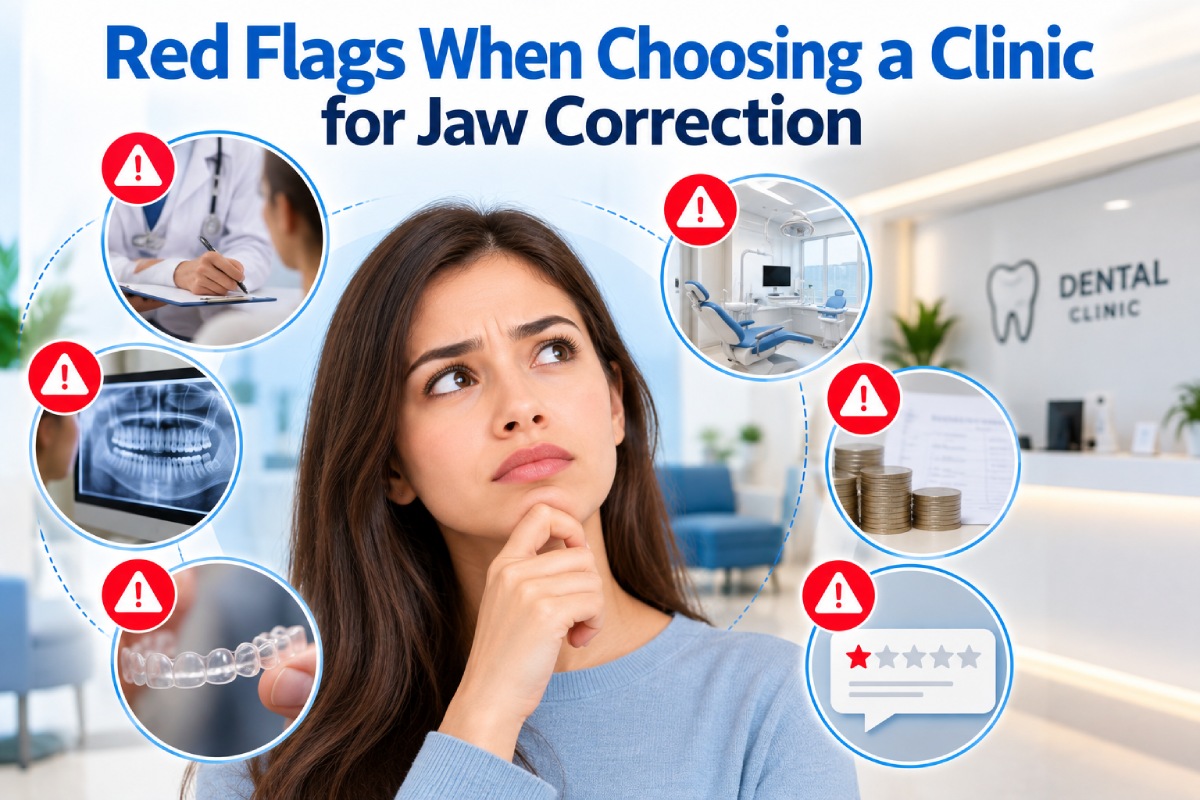
Red Flags When Choosing a Clinic for Jaw Correction
Price and appearance should not be the only factors when selecting an orthodontic provider.
Be cautious when a clinic:
- Promises to “reshape” an adult jaw using braces alone
- Guarantees a specific result without proper examination
- Recommends treatment without explaining the diagnosis
- Cannot explain whether the problem is dental or skeletal
- Uses the same treatment plan for every patient
- Focuses entirely on appliance appearance
- Gives an exact treatment duration without assessment
- Provides a price without explaining what is included
- Avoids discussing retention
- Cannot explain alternatives where alternatives exist
A responsible orthodontic consultation should involve diagnosis, realistic expectations, and a discussion of limitations.
How to Find an Orthodontist Close to You in Dubai
Patients often begin with searches such as “orthodontist close to me,” “best orthodontist near me” or “orthodontist specialist.” Location matters, but it should not be the only selection criterion. Orthodontic treatment can involve multiple appointments over many months, so convenience has genuine practical value.
Consider:
- Travel time: Regular orthodontic appointments are easier to maintain when the clinic is accessible.
- Parking: Convenient parking can make repeated visits substantially easier, particularly for families.
- Public transport: Accessibility may be important for patients who do not drive.
- Appointment flexibility: Families and working adults may benefit from clinics offering appointments that fit their schedules.
- Specialist availability: The clinic should have the appropriate orthodontic expertise for the problem being treated.
The ideal combination is therefore clinical suitability + accessibility, rather than simply choosing the closest clinic.
Why Specialist Orthodontic Assessment Matters for Jaw Correction
Not every alignment problem requires the same level of orthodontic expertise.
Straightening a few mildly rotated teeth is fundamentally different from managing:
- Significant skeletal discrepancy
- Severe overbite
- Underbite
- Open bite
- Impacted teeth
- Complex crowding
- Orthodontic-surgical cases
- Growth-related jaw problems
Patients should therefore look beyond generic claims such as “advanced braces” and ask who will actually diagnose and manage the case. A specialist orthodontist in Dubai can assess the relationship between the teeth, dental arches and jaws and determine whether the treatment objective is achievable through orthodontics alone.
Can Jaw Correction Treatment Improve Facial Appearance?
Orthodontic treatment can improve the appearance of the smile, and correcting tooth position can sometimes influence lip support and the visible facial profile. However, facial appearance should never be reduced to tooth alignment alone.
The final appearance is influenced by:
- Skeletal structure
- Teeth
- Lips
- Soft tissue
- Chin position
- Jaw position
- Facial proportions
If the primary concern is a significant skeletal discrepancy, a consultation may need to involve both orthodontic and surgical considerations. The goal should be to establish realistic expectations before treatment, rather than promising a particular facial transformation.
Why Retention Is Essential After Jaw Correction Braces
Finishing active orthodontic treatment does not mean the teeth are permanently locked into their new positions. Teeth can naturally change position over time. Retention helps maintain the alignment achieved during active treatment. Depending on the case, retainers may be removable, fixed, or a combination of both.
Retention is particularly important because:
- Teeth can relapse
- Growth and aging continue
- Soft tissues exert forces around the teeth
- Previous rotations can have a tendency to return
- The bite can change over time
Patients should ask about the expected retainer schedule and long-term maintenance before starting orthodontic treatment.
A successful orthodontic outcome is therefore not simply: Braces → straight teeth
It is: Diagnosis → treatment → bite correction → finishing → retention → long-term monitoring
Final Verdict: Are Jaw Correction Braces Right for You?
Orthodontic treatment braces can be an effective treatment when the underlying problem is primarily related to tooth alignment or a bite that can be corrected through orthodontic mechanics. They can address crowding, spacing, overbite, underbite, crossbite, and other malocclusions, while selected growth-modification approaches may be considered for children whose jaws are still developing. However, braces should not be confused with skeletal jaw surgery.
For adults with significant jaw discrepancies, orthodontics may be one part of a broader treatment plan that includes orthognathic surgery. The most reliable way to determine the right approach is a specialist orthodontic assessment that considers the teeth, bite, jaw relationship, facial growth, existing dental work, and long-term treatment goals.
For patients in Dubai, the objective should not simply be to find the cheapest braces or the most discreet appliance. It should be to find an appropriately qualified orthodontic provider who can explain what is causing the problem, what treatment can realistically change, how long it may take, and what will be required to maintain the result. Contact our orthodontic team to discuss your treatment concerns and arrange an assessment.
Frequently Asked Questions
What is orthodontic jaw correction treatment?
Orthodontic braces are orthodontic appliances used primarily to move teeth and improve the relationship between the upper and lower dental arches. In growing patients, selected orthopedic appliances may also influence aspects of jaw development. Significant skeletal discrepancies in adults may require jaw surgery.
Can braces correct a misaligned jaw?
Braces can correct tooth position and improve many bite problems. They cannot independently reposition a significantly misaligned adult jaw bone. If the discrepancy is skeletal and severe, orthognathic surgery may be considered.
Can clear aligners correct jaw alignment?
Clear aligners can correct many dental alignment and bite problems in appropriately selected cases. They are not a universal solution for significant skeletal jaw discrepancies. An orthodontic assessment is required to determine suitability.
What is the difference between jaw correction braces and jaw correction surgery?
Braces primarily move teeth and modify the dental bite. Jaw correction surgery changes the position of the jaw bones. In some complex adult cases, orthodontics and surgery are used together.
At what age should a child see an orthodontist?
An orthodontic evaluation can be useful when parents or a dentist notice significant crowding, crossbite, protruding teeth, underbite, or unusual jaw development. Early assessment does not necessarily mean immediate braces.
How long do orthodontic jaw correction treatments take?
Treatment duration depends on the severity and type of problem, age, tooth movement required, appliance, compliance, and whether surgery or additional appliances are involved. A personalised estimate should be provided after examination.
Are metal braces better than clear aligners?
Neither is universally better. Metal braces may provide advantages for certain complex tooth movements, while clear aligners may be suitable for many selected alignment and bite cases. The diagnosis should determine the appliance.
Is jaw correction surgery always necessary for an underbite?
No. Some underbites are primarily dental and may be corrected orthodontically. A significant skeletal underbite in an adult may require an orthodontic-surgical approach.
Can jaw correction improve facial symmetry?
It depends on the cause of the asymmetry. Orthodontics can improve dental alignment and bite, while significant skeletal asymmetry may require a different treatment approach. An examination is needed to determine the source.
How do I find the best orthodontist near me?
Look for appropriate orthodontic qualifications, experience with your specific type of bite problem, clear diagnostic procedures, realistic treatment planning, transparent pricing, and a clear retention plan. Location and appointment convenience are also practical considerations.