
Loose Tooth as an Adult: Can It Be Saved, or Does It Need Replacing?
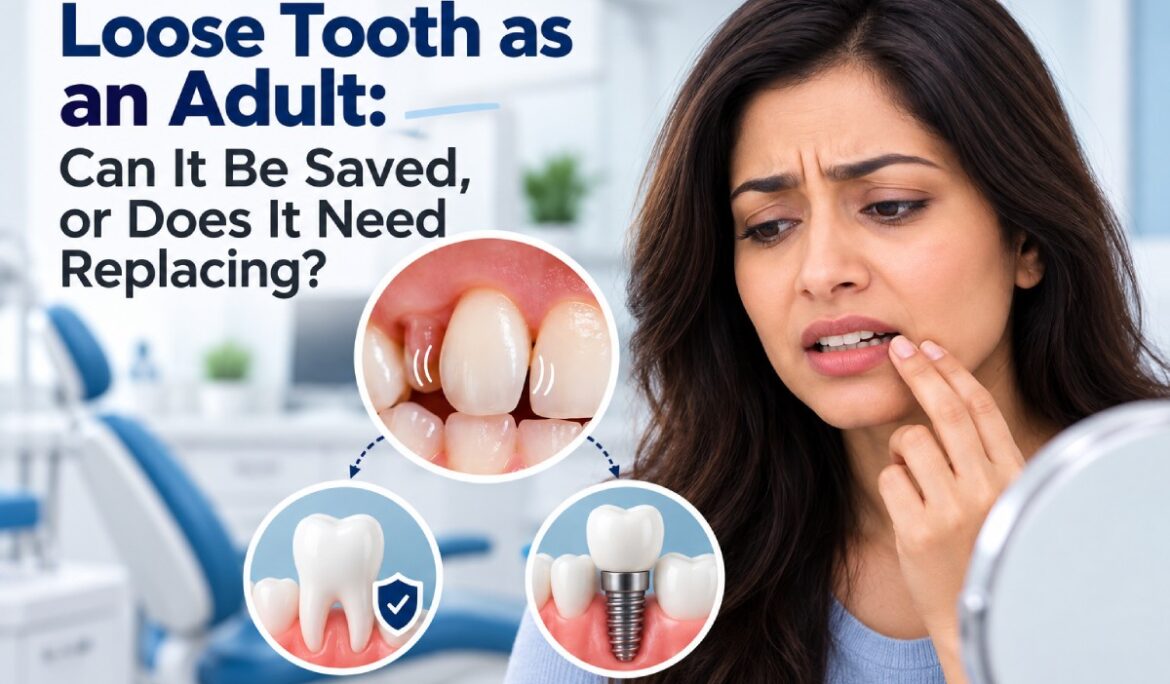
Loose tooth treatment in Dubai is not automatically about extraction. A loose tooth in an adult is never normal, but it isn’t automatically lost. Many loose teeth can be stabilised once the cause is found and treated. The most common causes are gum disease, infection, injury, and heavy biting forces. Whether a tooth can be saved depends mainly on how much supporting bone remains, whether the root is intact, and whether the underlying cause can be controlled. Loose tooth treatment in Dubai isn’t one procedure. A loose tooth might need gum treatment, a root canal, a bite adjustment, a splint, or in some cases extraction and replacement. The diagnosis decides which.
Quick Answer
A loose adult tooth may be saved if the supporting bone and root are healthy enough and the underlying cause can be treated. Gum disease, infection, trauma, grinding, and root fractures can all cause tooth mobility. Treatment may include periodontal treatment, root canal therapy, bite adjustment, or splinting. If the tooth has severe bone loss or a root fracture that can’t be repaired, extraction and replacement may be necessary.
Why Adult Teeth Become Loose
A healthy tooth isn’t completely rigid. It sits in its socket on a thin ligament and moves very slightly under pressure. A tooth feels loose when that support is inflamed, damaged, or lost. The most common causes of loose teeth in adults are gum disease, dental infection, injury, excessive biting forces, and root fractures.
| Cause | What is happening | Common signs |
| Periodontitis (gum disease) | Bacteria-driven inflammation destroys the ligament and bone around the tooth | Bleeding gums, gum recession, bad breath, teeth drifting or spacing |
| Dental abscess | Infection at the root tip or in the gum pushes on the supporting tissues | Pain, swelling, pus, tenderness when biting |
| Injury | A blow displaces the tooth or damages the ligament or root | Recent accident, tooth sitting in a different position, bleeding |
| Heavy biting forces | Grinding, clenching or a tooth that hits first overloads the support | Wear facets, jaw tiredness, one tooth taking the bite |
| Root fracture | A crack runs through the root, often in root-treated teeth | Localised gum pocket, recurring swelling, pain on biting |
Less commonly, cysts or other bone lesions cause looseness. Understanding the causes of loose teeth in adults is one reason an X-ray is part of every assessment. Orthodontic treatment also makes teeth slightly mobile while they move, but that’s expected and temporary.
Can a Loose Adult Tooth Tighten Again?
Sometimes. It depends on what caused the looseness. When the cause can be treated and sufficient support remains, loose tooth treatment without extraction may help preserve the natural tooth.
- Loose because of inflammation or infection: when the abscess or gum inflammation is treated, and enough bone remains, the tooth often becomes noticeably firmer as the tissues heal.
- Loose after an injury: a displaced tooth that is repositioned and stabilised can reattach, although it needs follow-up to check the nerve.
- Loose because of bone loss from periodontitis: bone lost to gum disease doesn’t usually grow back by itself. Treatment can stop further loss and reduce inflammation, and in selected defects regenerative procedures can rebuild some support. Some mobility may remain.
- Loose because of a vertical root fracture: these teeth usually can’t be saved predictably, and extraction is often recommended.
That’s why the first question isn’t “can this tooth be saved?” but “why is it loose?”
How a Dentist Assesses a Loose Tooth
A proper assessment usually includes:
- Mobility grading: how far and in which directions the tooth moves.
- Periodontal charting: pocket depths, bleeding, recession and gum health around the tooth and its neighbours.
- Radiographs: to show bone levels, the root tip, any infection, and signs of fracture. A 3D CBCT scan may be recommended when standard X-rays can’t answer a specific question, such as a suspected root fracture or planning for an implant.
- Vitality testing: whether the nerve is alive, which helps decide whether a root canal is needed.
- Bite analysis: whether the tooth is being overloaded.
- Medical history: smoking, diabetes control, and medications can affect gum health and healing.
Treatment Options That Can Save a Loose Tooth
Loose tooth treatment without extraction may be possible when enough supporting bone and healthy root structure remain. The right treatment depends on why the tooth has become mobile.
Gum disease treatment
A loose tooth due to gum disease needs more than temporary stabilisation. Treating a loose tooth due to gum disease also requires control of the underlying periodontal infection. The underlying periodontal infection has to be controlled to protect the remaining bone and supporting tissues.
Treatment starts with thorough cleaning above and below the gumline (scaling and root debridement) and better daily plaque control. Deeper or persistent pockets may need further non-surgical or surgical care. Periodontal treatment is the foundation of loose tooth treatment in Dubai and everywhere else, because stabilising a tooth without controlling the disease only postpones the problem. See our gum disease treatment page.
Treating a dental abscess
Tooth abscess treatment in Dubai depends on where the infection started. Infection from the nerve is treated with a root canal treatment, which removes the infected pulp and seals the canals. Infection that starts in a gum pocket is drained and cleaned as part of gum infection treatment. Antibiotics may help when infection is spreading, but they don’t replace treating the source.
Dental splint for a loose tooth
A dental splint for a loose tooth connects the mobile tooth to its neighbours with a thin wire or fibre bonded to the back of the teeth. A dental splint for loose tooth cases can improve comfort while the supporting tissues heal. A dental splint for loose tooth may also be used after certain injuries. The dentist decides whether a dental splint for loose tooth is appropriate based on mobility and the cause.
Bite adjustment and night guards
If one tooth takes too much of the bite, it can be adjusted slightly. For people who grind or clench, a night guard spreads and cushions the forces during sleep.
Treating exposed roots and recession
Loose teeth often have gum recession that leaves the root surface exposed and sensitive. Exposed root treatment in Dubai might include desensitising treatment, bonding over the root surface, or gum grafting once the disease is stable. Our gum recession treatment page explains the options.
When a Loose Tooth Needs Replacing
Extraction becomes the more predictable choice when:
- very little bone remains around the root, so the tooth can’t be supported long term;
- the root has a vertical fracture;
- infection keeps returning despite appropriate treatment;
- the tooth is so mobile that it affects eating and comfort, and treatment can’t improve it;
- keeping the tooth would put neighbouring teeth, the bone, or a future implant site at risk.
- Keeping a failing tooth for too long isn’t always the conservative choice. Ongoing infection can reduce the bone that would later support an implant. In such cases, a dental implant for loose tooth replacement may be discussed after the infection is controlled.
Replacement options
- Dental implant: a dental implant for a loose tooth may be considered when the tooth can’t be predictably saved and needs to be extracted. Implant treatment is planned after the gum disease or infection is controlled and the available bone has been assessed. Some sites need bone grafting first. See our dental implants page.
- Bridge: uses the teeth on either side for support. It can be suitable when those teeth already need crowns.
- Removable partial denture: a less invasive option, often used as an interim or when several teeth are missing.
Your dentist should discuss all of these, not just one.
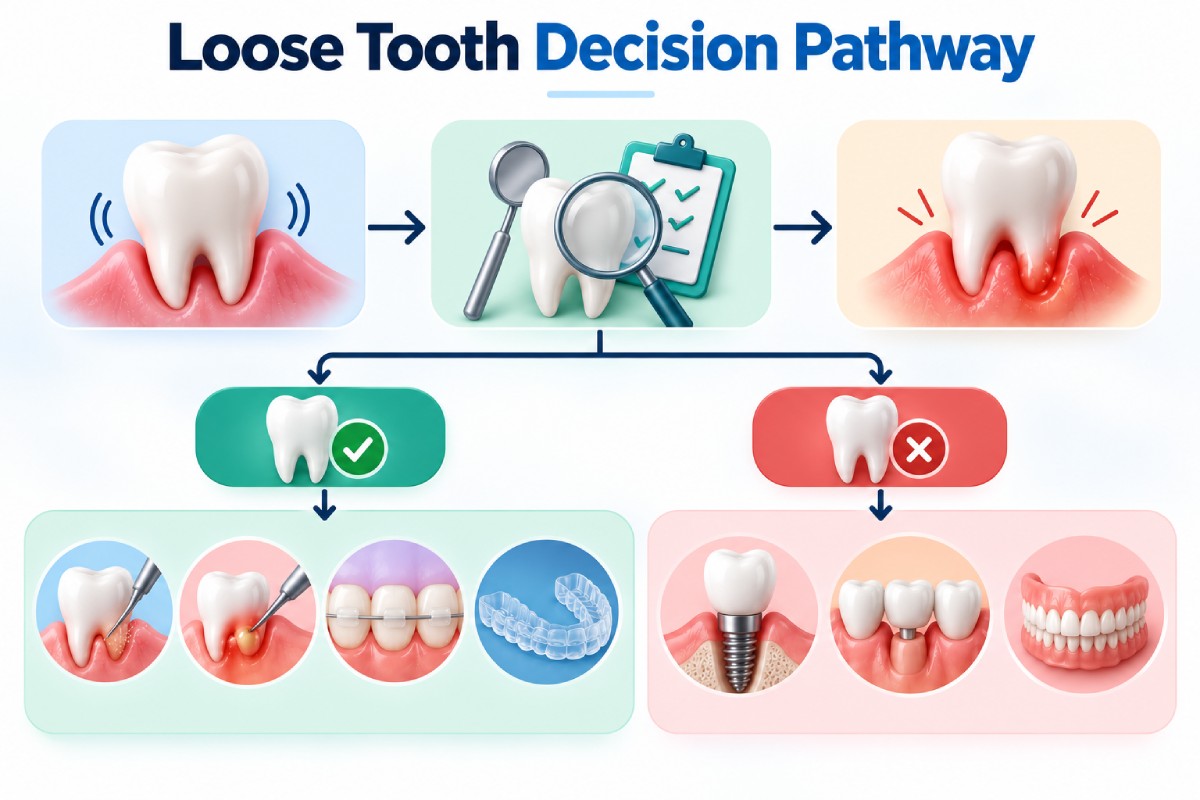
Loose Tooth Decision Pathway
For a loose tooth in adults, treatment follows a sequence:
- The tooth feels loose. Examination and X-rays follow.
- Is there infection or active gum disease?
• Yes: treat the infection or periodontitis first, then reassess mobility.
• No: check the bite, recent injury, and the root. - Is the root intact, with enough bone support?
• Yes: save the tooth with gum care, a root canal if needed, bite adjustment, and a splint if needed.
• No: extraction, then plan the replacement (implant, bridge or denture). - Maintenance: regular gum reviews to protect the saved tooth, or the new implant.
Examples of How the Assessment Changes
These examples show how the reasoning works; they aren’t case reports.
- A 42-year-old with bleeding gums and two slightly loose lower front teeth. The focus is periodontal charting and bone levels. Gum treatment usually comes first, with a splint considered if chewing is uncomfortable.
- A 38-year-old whose molar became loose and swollen over a week. An abscess is suspected. Vitality testing and X-rays determine whether it came from the nerve (root canal) or the gum (periodontal drainage).
- A 55-year-old with a root-treated tooth, a deep pocket on one side, and recurring swelling. A vertical root fracture is possible and may need CBCT to confirm. If it’s confirmed, extraction and implant planning follow.
- A 30-year-old whose front tooth was knocked in a sports injury. This needs urgent assessment, repositioning and stabilisation, followed by monitoring of the nerve over the following months.
When to Seek Urgent Care
See a dentist promptly, ideally the same day, if a loose tooth follows an injury, or if you have facial swelling, fever, pus or difficulty swallowing. Prompt loose tooth treatment in Dubai can help determine whether the tooth can be stabilised. After an injury, avoid wiggling the tooth, keep to soft food, and arrange care as soon as possible.
After dental trauma, prompt professional assessment and appropriate stabilisation can improve the chance of preserving the tooth. For other loose teeth, book an assessment soon rather than waiting to see if it settles. Mobility from gum disease tends to get worse quietly.
Loose Tooth Treatment in Dubai: Business Bay
At Bay Avenue Dental Centre, loose tooth treatment in Dubai starts with a diagnosis, not an assumption about extraction. Gum treatment, root canal therapy, and implant care are all available in one clinic. Dr. Alok Mehta, Specialist Periodontist & Implantologist, can assess whether a tooth can be kept and, if not, plan its replacement.
Bay Avenue Dental Centre is at The Regal Tower, Office 1701, Business Bay, Dubai.
Loose Tooth Treatment: Dubai Patients’ Common Questions
Can a loose adult tooth be saved?
Often, yes, if the cause is treatable and enough bone and root structure remain. Teeth loose from infection or inflammation frequently firm up after treatment.
What is the treatment for a loose tooth in adults?
Loose tooth in adults treatment depends on the cause. Treatment for loose tooth in adults may include gum disease treatment, root canal treatment, bite adjustment, a night guard, splinting, or extraction and replacement.
Does a loose tooth always need extraction?
No. Many loose teeth can be kept once gum disease, infection or bite overload is treated. Loose tooth treatment without extraction may be considered when enough bone and healthy root structure remain.
Will a loose tooth tighten on its own?
Rarely, unless the cause was minor and temporary. Most loose adult teeth need the underlying problem treated.
Can gum disease make teeth loose?
Yes. Periodontitis is one of the most common causes of loose teeth in adults because it destroys the ligament and bone that hold teeth in place.
Can an abscess cause a loose tooth?
Yes. An abscess can make a tooth temporarily loose. Once the infection is treated, the tooth often becomes firmer if enough bone remains.
Does splinting fix a loose tooth permanently?
No. A splint stabilises the tooth for comfort and healing. The cause, such as gum disease or bite overload, still needs to be treated.
Can I get an implant if I lost a tooth to gum disease?
Often, yes, once the gum disease is controlled. A dental implant for loose tooth may be considered after the bone and gum health have been assessed. Bone grafting may be needed where bone has been lost.
Is a loose tooth an emergency?
It’s urgent after an injury, or if there’s swelling, fever, or pus. Otherwise, arrange an assessment soon.
Have a tooth that feels loose? An examination can find the cause and show whether the tooth can be saved before any decision about extraction is made.
Book loose tooth treatment in Dubai at Bay Avenue Dental Centre, Business Bay · +971 55 146 5512 · +971 4 277 0247 · info@bayavenuedc.com